A plea bargain is an agreement between a defendant and a prosecutor: the defendant pleads guilty, and in return the prosecution offers a lighter punishment or drops some charges. It is the reason most criminal cases in the United States end without a trial. The jury that TV dramas put at the center of the story never shows up in the vast majority of real ones.
The deal matters because a plea is not a formality. Once a court accepts a guilty plea, the defendant is convicted, and the judge moves to sentencing. That is a permanent legal act, not a handshake. This article explains how the machinery works, what a defendant gives up, and where the known limits are. It is information, not legal advice; anyone facing actual charges should speak with a qualified lawyer.
The vocabulary first. As Wikipedia's overview of the plea explains, a plea is a defendant's formal response to a criminal charge, and the most common answers are guilty and not guilty. Some systems allow more: nolo contendere, or no contest, in which the defendant neither admits nor denies the offense, and the Alford plea, in which a defendant maintains innocence while acknowledging the evidence is strong. A guilty plea entered with no deal in place is called a blind plea.
What exactly is a plea bargain?
A plea bargain is a negotiation. The prosecutor and the defense discuss an agreement for a guilty plea in exchange for a more lenient punishment, or for related charges to be dropped. The bargain can take different shapes: a reduced charge, a lighter recommended sentence, or the dismissal of companion counts. Each version trades certainty for the defendant against the risk of a trial.
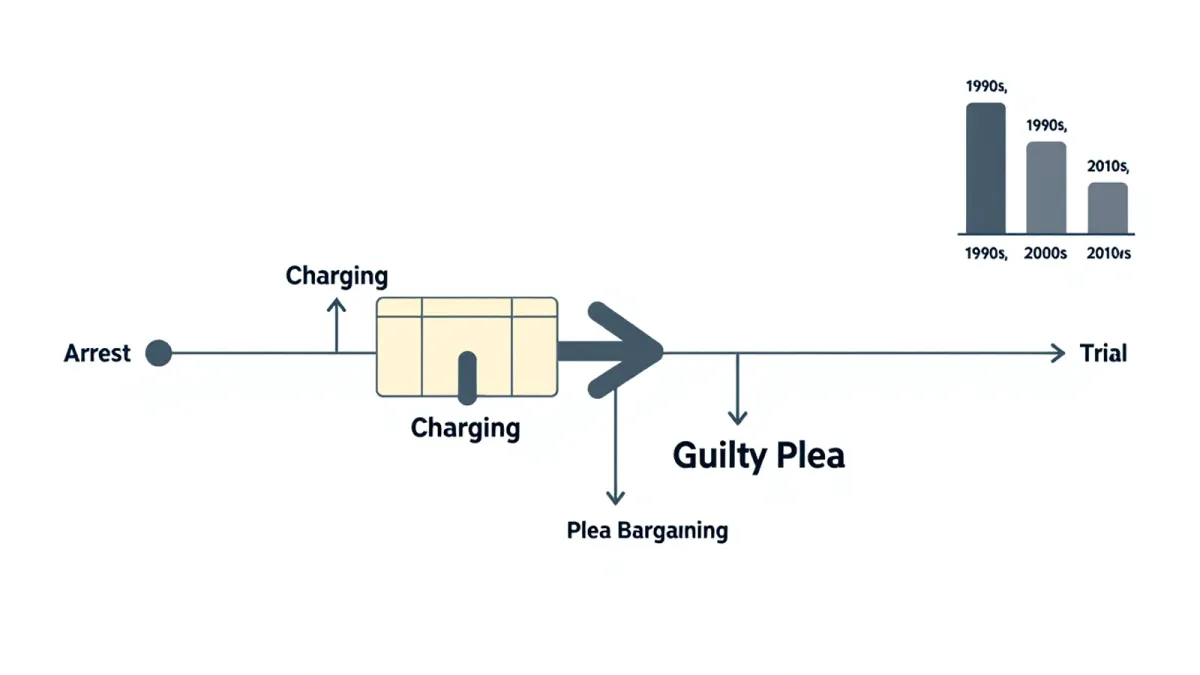
The deal usually happens between the arraignment and the trial date. At the arraignment, the defendant first answers the charge, and many defendants plead not guilty at that stage even when a deal is likely later. The early not-guilty plea preserves rights while both sides review the evidence and negotiate. Everything that follows flows from that first answer.
Why would a prosecutor offer anything? Because trials are expensive, slow, and uncertain. Why would a defendant accept? Because a trial carries the worst-case outcome. The bargain lets both sides replace uncertainty with a known result. That mutual risk-aversion, more than any single rule, is what keeps most cases out of the courtroom. Readers following this should also see How plea bargains work, and why most criminal cases end without a trial.
What does a defendant give up by pleading guilty?
The trial itself, and everything that comes with it. A guilty plea waives the right to a jury trial. It also skips the process where the prosecution must prove the case and the defense can contest it. The conviction rests on the defendant's own admission instead.
Courts do not accept that admission automatically. Under the Federal Rules of Criminal Procedure, Rule 11 sets strict procedural requirements for accepting pleas, as the legal reference site LawDefiner explains in its guide to plea meaning in law. In practice, the judge conducts what is called a plea colloquy: a series of questions confirming that the defendant understands the charges, the rights being waived, and the consequences of the plea.
The standard comes from the United States Supreme Court. In the 1938 case Johnson v. Zerbst, the Court held that a waiver of rights must be made "knowingly, voluntarily and intelligently," according to Wikipedia's account of US criminal procedure. The hearing is typically transcribed and kept in the permanent record, precisely so the conviction's validity can be defended against a later challenge.
"Voluntary" has its own settled meaning in the case law. It rules out improper inducements such as bribes or physical violence, but it does not rule out the ordinary inducements of charge and sentence bargaining. That line matters: the deal itself is legal pressure, and the courts have treated it as such, within limits.
What are the types of pleas, and how do they differ?
Four answers cover most of the ground. Each carries a different legal meaning and a different practical consequence, especially outside the criminal case.
| Plea | What it means | Practical effect |
|---|---|---|
| Guilty | The defendant admits the charge | Conviction and sentencing follow |
| Not guilty | The defendant contests the charge | The case proceeds toward trial |
| No contest (nolo contendere) | The defendant accepts punishment without admitting guilt | Treated like a guilty plea for sentencing, but generally cannot be used as an admission in a later civil lawsuit |
| Alford plea | The defendant maintains innocence while acknowledging the evidence is strong | Treated as a guilty plea for sentencing; the conviction still goes on the record |
The no-contest plea shows why the choice is strategic, not just moral. LawDefiner's example: a driver charged with reckless driving pleads no contest, takes the criminal sentence, and the plea generally cannot serve as an admission in a personal-injury lawsuit over the same accident. Not every state allows no-contest pleas in every type of case, which is one more reason the choice needs a lawyer's input.
The Alford plea, from the 1970 Supreme Court case North Carolina v. Alford, exists for defendants who will not say they did it but do not want to gamble on a trial. The court treats it as a guilty plea. The defendant keeps a conviction record either way.
How does the deal actually get made?
In broad outline, the sequence runs like this. The exact mechanics vary by jurisdiction, so treat this as the general shape rather than a fixed rule.
- Charges are filed, and the defendant is arraigned and pleads, usually not guilty at first.
- Both sides investigate: the prosecution reviews its evidence, the defense looks for weaknesses and reviews discovery.
- The parties negotiate, directly or through their lawyers, over charges, sentence recommendations, or both.
- If they agree, the defendant enters the negotiated plea in open court, and the judge runs the plea colloquy.
- The judge decides whether to accept the agreement. Acceptance leads to sentencing; rejection sends the case back toward trial.
One detail worth knowing: the judge is not bound by everything the parties agreed. If the deal involves a sentence recommendation, the court may accept the plea but still impose a different sentence, depending on local rules. A defendant entering a plea needs to understand which parts of the deal the court can change.
Do other countries use plea bargains?
Yes, but far more narrowly. Wikipedia notes that plea bargains are particularly common in the United States, while other countries use more limited forms. In the United Kingdom and Germany, guidelines state that only the timing of the guilty plea can affect the reduction in punishment, with an earlier plea earning a greater reduction. The discount is fixed and public; the charge itself is not traded.
The contrast is instructive. The American system lets the parties negotiate both the charge and the recommended sentence. The British and German systems confine negotiation to one variable. Same basic idea, very different machinery, and very different room for disparity between similar cases.
What this means: the known pressures and the open questions
Our analysis of the documented record points to two things a reader should carry away. First, the plea bargain is the default path, not the exception, and it works because both sides fear the trial's uncertainty. Second, the pressures that produce pleas are not always the clean kind. Empirical research has found that violent conditions in jails during pretrial detention of people who are legally innocent can improperly induce or coerce guilty pleas, according to the research summarized by Wikipedia. The same account notes that this has not constitutionally invalidated those pleas under current Supreme Court precedent. The coercion is documented; the remedy, so far, is not. We covered a connected angle in How bail works, and what actually decides who goes free before trial.
There is also a structural asymmetry. Wikipedia reports that virtually all jurisdictions hold that defense counsel need not discuss with defendants the collateral consequences of pleading guilty, such as consecutive sentencing or treatment as an aggravating circumstance in an ongoing capital prosecution. A defendant can validly plead guilty without being told about consequences that follow the conviction elsewhere in the law. For a system in which most convictions come by plea, that is a gap worth naming, not a footnote.
What the record establishes is the mechanism: a plea is a legal act, the deal is a negotiation, and the court's job is to confirm the plea is knowing and voluntary. What remains unsettled is the harder question of how much pressure the system should be allowed to apply to fill that mechanism. Readers who want the surrounding process can follow how bail decisions shape the pressure a defendant feels before any negotiation starts, or how federal sentencing guidelines frame what a negotiated sentence looks like.