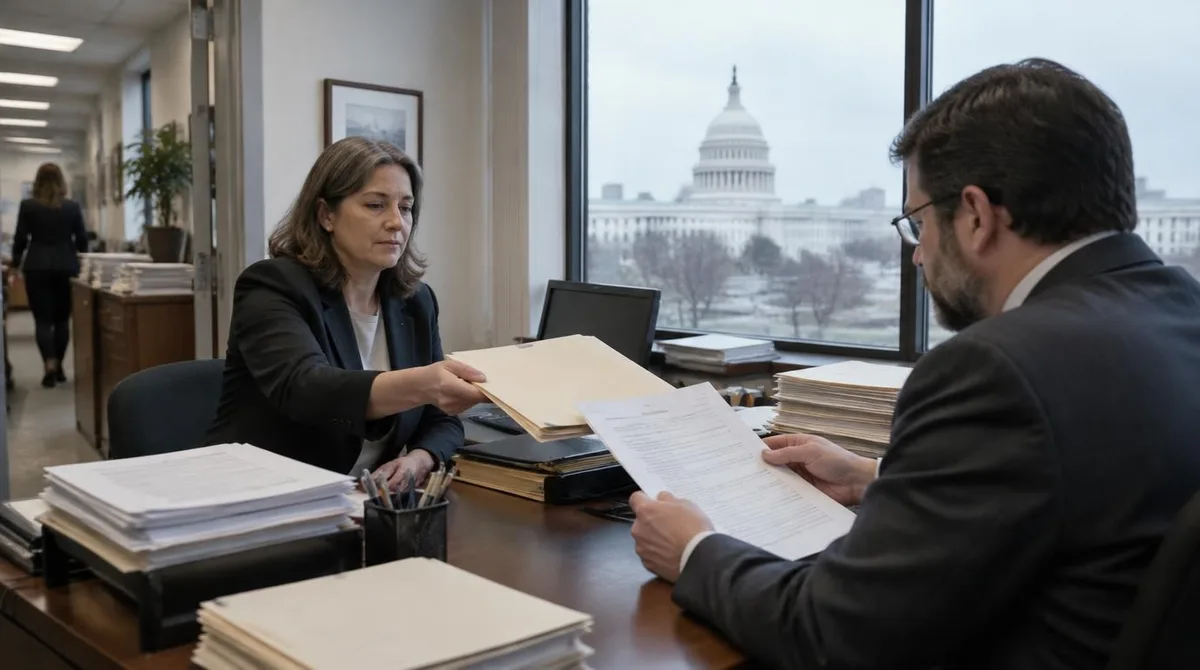
A whistleblower case moves through the legal system in fixed steps. An employee makes a protected disclosure. An inspector general or the Office of Special Counsel takes the complaint. The Merit Systems Protection Board hears retaliation claims. Intelligence reports of urgent concern reach Congress under their own law. Each step has a named office and a clock.
The route changes with the job. Most federal workers use the civil service track, written in 1989. Intelligence workers follow a separate 1998 law built for classified information. Both rest on one idea: a report of official wrongdoing should reach an office able to act.
What counts as a protected disclosure?
Under the Whistleblower Protection Act of 1989, a protected disclosure reports a possible violation of law, rules, or regulations, mismanagement, gross waste of funds, abuse of authority, or a substantial and specific danger to public health or safety, per the statute's text. An agency violates the act when it takes or threatens retaliatory action against a worker or applicant because of such a disclosure. The covered categories come straight from the law. Policy disputes do not qualify in the intelligence track, and the civil service track has court-made limits of its own.
Who handles a federal whistleblower complaint?
The Office of Special Counsel looks into complaints from federal workers. Its stated mission is shielding employees from personnel practices the law bars, above all reprisal for whistleblowing, per the record of the office's work. The Merit Systems Protection Board hears the retaliation cases, with appointed judges. Appeals go to a single court, the Court of Appeals for the Federal Circuit. Wins for workers are rare on the available record. The board ruled for whistleblowers three times in 56 merits cases since 2000, and the appeals court did so in three of 203 more from 1994 to 2010, per a Government Accountability Project analysis. This connects to our earlier piece, How federal sentencing guidelines work after Booker made them advisory.
How do intelligence community reports reach Congress?
The Intelligence Community Whistleblower Protection Act of 1998 sets its own route. A worker who plans to report an urgent concern about an intelligence activity may take the complaint to the agency inspector general or the intelligence community's own inspector. That inspector has 14 days to decide whether the complaint appears credible. If it does, the agency head and the Director of National Intelligence must send it to the congressional intelligence committees within seven days. If it is not forwarded, the worker may go to the committees directly, after informing the inspector first.
What does the intelligence track produce in practice?
The counts are small, per the Office of the Director of National Intelligence. From 1999 to 2009, ten complaints were filed under the 1998 law, and inspectors found four credible. Three whistleblowers claimed retaliation in those cases, and later probes found no proof of it, per the same office. The low first-decade volume shows how narrow the formal channel is.
What do these laws not cover?
The gaps are on the record. The 1998 law does not bar job retaliation and gives no way to challenge it, which led a Pentagon acting inspector general to tell Congress in 2006 that the act's name is a misnomer. A Brennan Center analyst has put the same point more bluntly: a right to report with no remedy is no right at all. On the civil side, the Supreme Court held in Garcetti v. Ceballos in 2006 that speech made as part of official duties lacks First Amendment protection.
Conclusion: offices, clocks, and narrow doors
A whistleblower case is less a drama than a chain of offices and deadlines. The disclosure goes to an inspector or a counsel's office. Credibility gets a 14-day clock, and forwarding to Congress gets seven days. Retaliation claims land at a board that rarely rules for the worker. The laws set who may report, to whom, and how fast, and the record shows both working channels and sealed ones. The statutes, not any single case, remain the map of the path. For related coverage, see How statutes of limitations work in criminal cases, and when the clock stops.