A police academy is a school where new law enforcement officers complete the basic training a state requires before sworn work begins. The federal count put the average requirement at 806 hours in 2022. The same count logged 747 academies training 60,214 recruits, per the Bureau of Justice Statistics.
Those figures come from the Census of Law Enforcement Training Academies. The bureau has run the survey on a periodic basis since 2002. It covers academies that provide mandatory basic training for newly appointed officers. It records who runs each school, how long courses last, what they teach, and how many recruits finish. We covered a connected angle in Law enforcement ranks: Who outranks whom, explained.
Who runs the academies?
Law enforcement entities operated 414 of the academies counted in 2022, per the federal census. Colleges and technical schools operated 333 more. Two-year colleges alone trained 21 percent of starting recruits. Municipal police departments trained the same share. State POST organizations operated 4 percent of academies, yet trained 16 percent of starting recruits, per the report.
How long does basic training last?
The national average requirement was 806 hours in 2022, according to the Bureau of Justice Statistics. That number is a mean, not a mandate. Each state sets its own minimum, so course length varies widely. Recruit volume has moved as well. In 2022, 60,214 recruits started at 747 academies. In 2018, 59,511 recruits started at 681 academies, per the same report. The bureau adjusts both counts for nonresponse. For related coverage, see Military police explained: How defense departments police their own ranks, from base patrol to overseas authority.
What does the curriculum cover?
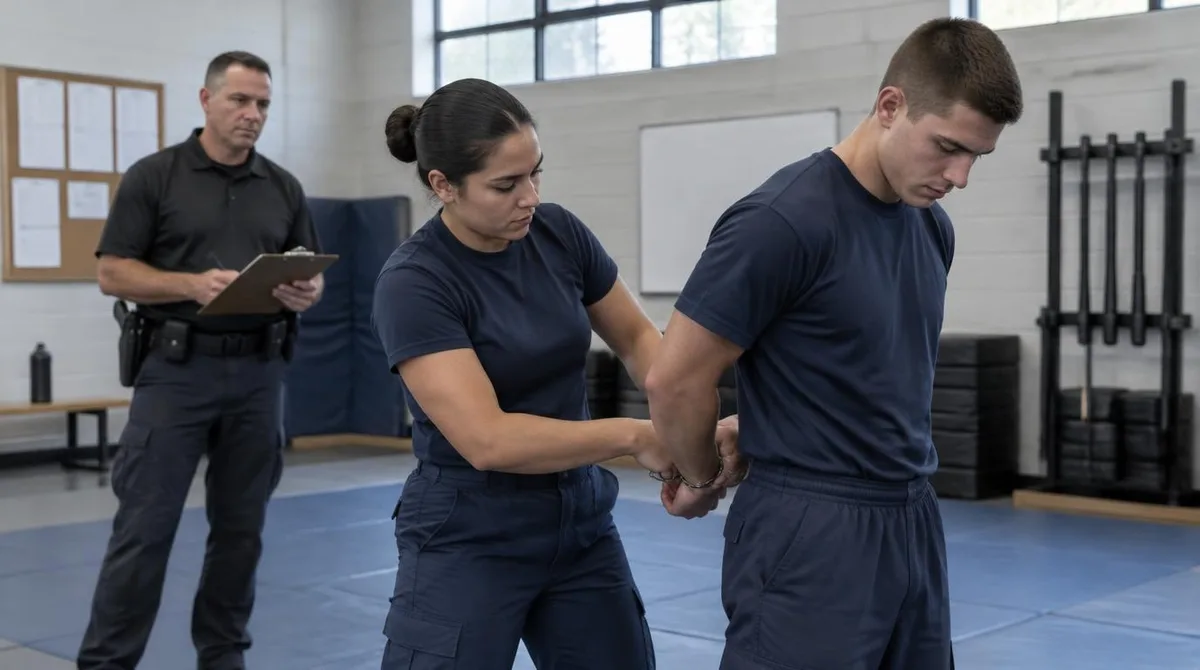
The course mix blends law, tactics, and applied drills, per BJS statistical tables. Nearly all recruits, 99 percent, were trained on responding to persons with mental illness or behavioral health issues. That subject drew an average of 21 hours. Most recruits also ran role-play scenarios. The tables count 98 percent trained in arrest control tactics and 97 percent in verbal tactics. Sixty-eight percent of academies taught with use-of-force simulators, and those schools covered 75 percent of all recruits.
Who attends the academies?
Eighty percent of starting recruits were male, and 20 percent were female, per the census. About one third held a degree at entry. Fourteen percent carried an associate degree, and 20 percent held a bachelor degree. Fourteen percent were military veterans. White recruits made up 59 percent of the starting class, a smaller share than in 2018. The shares of black, Hispanic, and other-race recruits were all higher in 2022 than at any point since 2006, per the report.
What share of recruits finish?
Completion stood at 85 percent in 2022, per the Bureau of Justice Statistics. More than 14 percent did not finish basic training. Eight percent left involuntarily, and 5 percent withdrew by choice. About 1 percent left for other or unknown reasons. The report counted 51,144 completions among 60,214 starters. Completion ratios ranged from 77 percent to 89 percent across racial and ethnic groups.
What happens after graduation?
Graduation routes most recruits into a second phase. Eighty-nine percent of academies required a separate field training after basic training, per BJS. Twenty-nine percent of those academies ran the field training themselves. In the field, a new officer works under an experienced trainer. The phase ends before any solo assignment, and its records follow an officer into the first years of service. Because the field phase is separate, the full formation period runs longer than the 806-hour average suggests.
Conclusion: What the counts add up to
The federal picture is a long, measurable pipeline. The average course ran 806 hours. Eighty-five percent of recruits finished. Eighty-nine percent of academies added a field phase after basic training. Each step has a number attached, and the census repeats on a set schedule. That gives the public a way to trace how a recruit becomes an officer, one gate at a time.