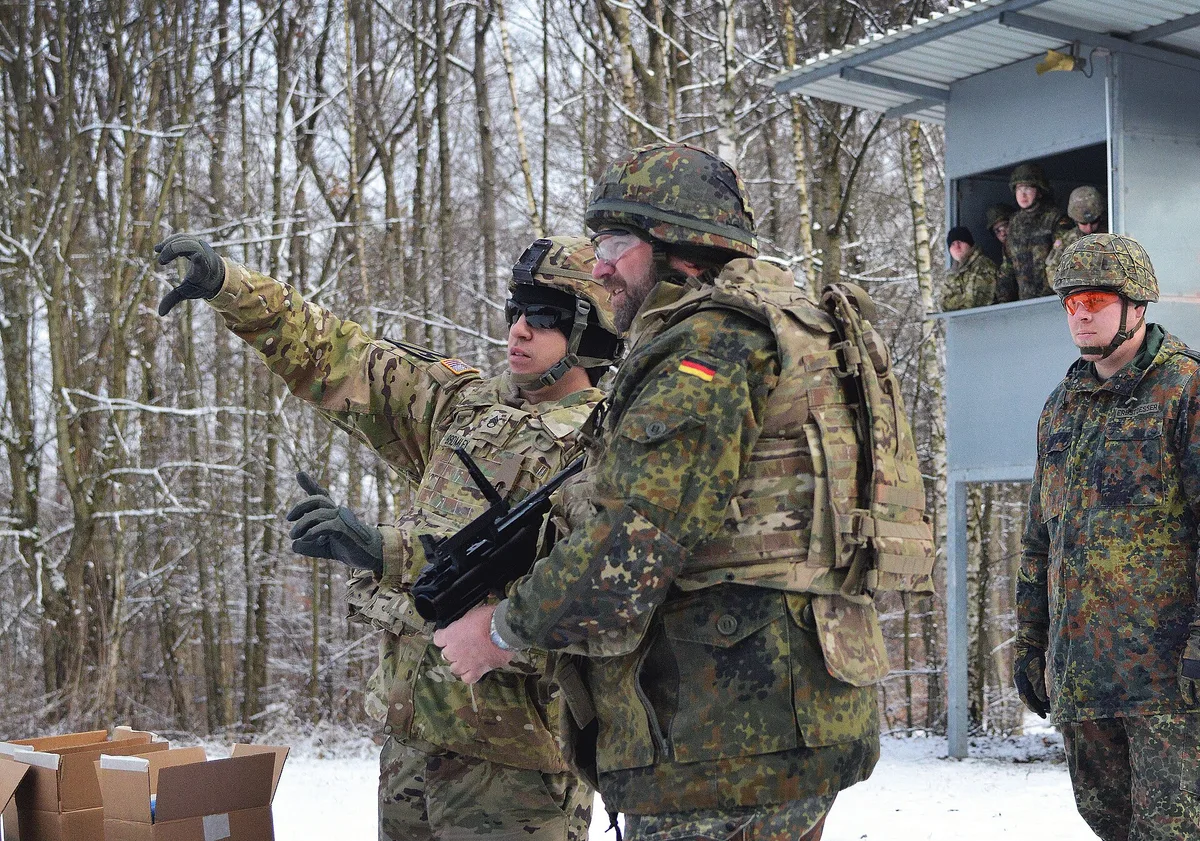
Military police are law enforcement officers who belong to the armed forces itself. They patrol bases, investigate service-member offenses, guard detainees, and enforce the Uniform Code of Military Justice, the separate criminal code that governs troops. Their authority comes from the defense department they serve, not from a city or county sheriff.
That structure creates a system most civilians never see. A soldier accused of a crime may face a military prosecutor instead of a district attorney, a military judge instead of a state court, and a military prison instead of a county jail. The U.S. Department of Defense, the cabinet-level department overseeing the armed services, sits at the top of that structure, with each service branch running its own policing arm beneath it.
This explainer covers who military police are, what jurisdiction they hold, how investigations work inside the ranks, and what happens when a service member's case crosses into civilian hands. Readers looking for the broader legal frame can start with Military law vs. civilian law: key differences, explained.
Who are military police, and what do they actually do?
Military police, often shortened to MP, are uniformed service members assigned to policing duties. In the United States, each branch maintains its own force: the Army and Marine Corps call theirs military police, the Navy uses masters-at-arms, and the Air Force fields security forces. The exact titles differ. The core tasks are similar.
Day-to-day work falls into a few buckets. Patrol and installation security covers gate control, base patrols, and response to on-base incidents. Investigations of lower-level offenses, such as theft or disorder within a unit, may be handled by MP units or referred upward. Battlefield duties add a third layer: MP units run detainee operations, control movement around combat zones, and escort prisoners of war.
That last role separates military police from almost any civilian counterpart. A municipal officer never takes custody of enemy combatants. An MP may. The job is therefore part policing, part military discipline, and part wartime operations, and the rules shift depending on which role applies at a given moment.
What jurisdiction do military police actually hold?
Jurisdiction is the legal power to act, and for military police it is narrower than many assume. In the United States, MP authority on a military installation is broad: they can detain, investigate, and process service members and, with the installation commander's authorization framework, exercise law enforcement powers over civilians on the base as well. Off the base, their authority over civilians largely ends. A service member who commits an offense in a civilian community may face civilian police and civilian courts instead of, or alongside, military ones.
Service members themselves remain under the Uniform Code of Military Justice anywhere in the world. That means an MP or military investigator can pursue a case against a soldier for conduct far from any base, even where civilian police decline to act. The two systems can overlap on the same facts, and memoranda between military and civilian agencies determine who leads.
Commanders hold a distinctive piece of this jurisdiction. In the military system, the authority to convene a court-martial, to order an investigation, and in many cases to decide discipline rests with the accused's chain of command, not with an independent prosecutor's office. Critics have long argued this blurs policing and command interest. Defenders argue it keeps discipline responsive to unit needs. Both positions appear regularly in policy debates; the structure itself is settled law.
How do investigations work inside the ranks?
Minor offenses typically stay within the unit. A commander may order a preliminary inquiry, impose non-judicial discipline for lesser misconduct, or separate a service member administratively. These routes never produce a criminal conviction, which matters for how the record is later understood.
Serious offenses move to specialized agencies. The services maintain dedicated investigative bodies staffed by special agents, most of whom are civilians or warrant officers rather than MPs. These agents handle major crimes, including sexual assault, homicide, and fraud, and their reports feed either command action or a court-martial. The separation between the patrol force and the investigative agency is deliberate: it keeps felony investigations out of the unit's own hands.
Court-martial is the military trial. A military judge presides, panel members drawn from the service act as the jury in contested cases, and the accused has the same presumption of innocence a civilian defendant holds. Verdicts and sentences are reviewed through military appellate courts before they become final. The process parallels civilian criminal procedure more than it resembles command discipline, and What internal affairs investigations do, and how discipline gets decided offers a civilian comparison for the disciplinary side.
What authority do military police hold overseas?
Overseas is where the system gets complicated. A base in another country exists by agreement with that country. Under a status-of-forces agreement, the standard treaty framework governing stationed troops, the host nation and the sending nation divide criminal jurisdiction over service members. Depending on the agreement, a service member accused of an offense against local civilians may be tried by the host country's courts, by military court, or, in practice, by whichever side the agreement and the facts assign the case.
Host-nation law applies to everyone on host-nation soil. Military law applies to the troops. When both claim the same case, the agreement resolves the conflict, and in some treaties the sending nation waives its claim in favor of local trial. For MPs on the ground, this means an arrest near a foreign base can trigger diplomatic processes, not just a booking procedure.
In actual combat zones, where no functioning local court exists, military authorities typically handle all enforcement involving their own personnel. Detainee handling follows the law of armed conflict rather than domestic criminal codes. These are different legal regimes stacked on the same patch of ground, and which one governs depends on the person, the act, and the status of the conflict.
What this means for accountability
Our analysis of the structure points to one recurring tension: the same institution employs the police, the prosecutors' chain of command, and the accused's bosses. Civilian systems separate these functions across agencies and elected officials. Military systems concentrate them, on the argument that discipline is a military necessity.
Reform debates tend to focus on the seams. Who investigates senior officers? What happens when the accused outranks the investigator? How do victims in the ranks gain access to a process independent of their command? Each service has adjusted its procedures over time, and legislatures periodically rewrite the jurisdictional lines, particularly around serious offenses. The direction of those changes, and how far they go, remain live policy questions rather than settled outcomes.
For readers tracking these questions, the practical takeaway is procedural. A case's path depends on where it happened, who it involved, and which legal code attaches to the accused. Those three facts, more than the severity of the allegation, determine whether an MP, a special agent, a civilian officer, or all three touch the case. Related coverage of how enforcement authority is structured across systems appears on the Enforcement section, and the Law enforcement ranks: Who outranks whom, explained piece covers how rank maps onto authority in both military and civilian forces.
Where the system ends and open questions remain
The evidence establishes the architecture: separate codes, command-held jurisdiction, treaty-bound overseas authority, and investigative agencies insulated from unit command. What remains unsettled is how much independence from command the system should have, and how the balance between military discipline and civilian-style due process should shift as standards evolve. Those questions are decided by legislatures and service policy, not by the police forces themselves, and they will keep changing the job description of the people who police the ranks.