A plea bargain is an agreement in which a defendant pleads guilty, or pleads no contest, to a criminal charge in exchange for concessions from the prosecutor, such as reduced charges or a lighter sentencing recommendation. It is the ordinary way American criminal cases end. Scholars and the Department of Justice's Bureau of Justice Assistance estimate that roughly 90 to 95 percent of state and federal cases are resolved by plea rather than trial, per Cornell Law School's Legal Information Institute.
That share is the answer to the puzzle in the headline. Jury trials are rare not because crimes are rare, but because both sides usually prefer a negotiated outcome. The prosecutor gets a conviction without the cost and risk of trial. The defendant gets certainty about the charge and, usually, the sentence. This article explains how the process works and what each side gains and gives up. It is information about legal process, not legal advice; anyone facing actual charges should consult a qualified defense lawyer. This connects to our earlier piece, What the college admissions bribery case showed about federal fraud charges.
The mechanics matter because the plea, not the trial, is where most criminal-case outcomes are actually decided. Understanding the deal structure, and the role judges play in approving it, is the key to understanding how the courts work in practice. Our cases coverage returns to this repeatedly, because nearly every resolved case passes through it.
What exactly is a plea bargain?
A plea bargain is a negotiated agreement between the prosecution and the defense in which the defendant pleads guilty to some or all charges in exchange for concessions. The concessions typically take one of three forms: the prosecutor reduces the severity of the charge, dismisses some of the counts, or agrees to recommend a more lenient sentence. In practice, courts treat the finished agreement much like a contract between the two sides, according to Cornell's Legal Information Institute.
The defendant's side of the exchange is a waiver of rights. By pleading guilty, a defendant gives up three protections under the Fifth and Sixth Amendments: the right to a jury trial, the right against self-incrimination, and the right to confront witnesses against them. The Supreme Court has held since its 1970 decision in Brady v. United States that plea bargaining is constitutional, provided the plea is voluntary and the defendant understands its consequences, per Cornell.
Some agreements ask more than a plea. Prosecutors sometimes offer favorable terms to defendants who agree to testify for the state against other defendants, Cornell notes. Cooperation deals are common in complex fraud and organized prosecutions, where a cooperator's testimony can be the government's central evidence.
What is the difference between charge bargaining and sentence bargaining?
Charge bargaining is an agreement about what the defendant will plead to. The most common form is pleading guilty to a lesser offense than the one originally charged. A related form, count bargaining, involves pleading guilty to a subset of multiple charges, with the rest dismissed. These shapes are described in the Wikipedia overview of plea bargaining, which also notes the practice's spread across common law systems.
Sentence bargaining is an agreement about the punishment itself. The parties settle the expected sentence before the plea is entered. In some jurisdictions, prosecutors and defendants can even work with judges to predetermine the sentence; in most, the judge's role is narrower. In the federal system, judges retain final authority over sentencing and are not bound by a prosecutor's recommendation, even when that recommendation is part of a deal, according to Cornell.
The distinction matters because the two bargains allocate risk differently. A charge bargain caps the offense of conviction, which limits the sentencing range whatever the judge does. A sentence bargain fixes the expected outcome, but a judge who is not bound by the recommendation can still depart from it. Which form is available, and how firm it is, varies by jurisdiction.
Why do prosecutors and defendants agree to deals?
Each side is trading uncertainty for a known result. For a defendant who believes conviction is nearly certain, a guaranteed reduction is worth more than a small chance of acquittal. For the prosecutor, a plea secures a conviction without the time and expense of trial preparation, per the Wikipedia overview. Trials also require victims and witnesses to testify, which can be traumatic; a plea spares them that.
The system-level incentive is volume. Writing in Judicature, Duke Law School's journal, a group of scholars and practitioners convened in 2022 described plea bargaining as an engine of efficiency that keeps enormous caseloads moving. John Flynn, president of the National District Attorneys Association and the district attorney in Erie County, New York, told the roundtable that after pandemic-era backlogs, plea bargaining had become a "necessity" rather than an efficiency: without it, he said, the system would "literally shut down."
Defenders of the practice frame it as a voluntary exchange that leaves both parties better off. Defendants hold trial and appeal rights, and they waive them knowingly in exchange for a concrete commitment. Critics answer that the exchange is not as voluntary as it looks, a point the next section takes up.
What are the criticisms of plea bargaining?
The core criticism is coercion. Because the gap between a plea deal and a post-trial sentence can be wide, defendants face pressure to plead even when the evidence against them is weak. The Wikipedia overview records the argument, associated with legal historian John Langbein, that plea bargaining is coercive in kind, if not in degree, and amounts to "condemnation without adjudication."
Innocent defendants are not exempt from that pressure. The National Registry of Exonerations has found that since 1989, about 20 percent of exonerations it reviewed involved people who had pleaded guilty to crimes they did not commit, and the Innocence Project found guilty pleas in roughly 11 percent of 300 exonerations it examined, according to a St. Francis School of Law analysis. A guilty plea, in other words, is not proof of guilt.
Critics also point to structural tools that tilt negotiations: pretrial detention on unaffordable bail, mandatory minimum sentences that raise the stakes of going to trial, and limited transparency during negotiations. The resulting gap between plea sentences and trial sentences is often called the "trial penalty." In the Judicature roundtable, professor Carissa Byrne Hessick argued that plea bargaining has become the default in practice while the legal rules still treat trial as the default, leaving the process under-regulated. Other scholars, including Jeffrey Bellin, counter that the right comparison is not the ideal trial but the real alternative, and that for many defendants a plea is still the better available outcome.
One further caveat belongs here. Police accounts, prosecutor statements, and defense claims are each owned by their sources, and a plea is no different: a guilty plea is an admission the defendant chose to make, usually on counsel's advice, in a specific bargaining position. It establishes what was pleaded, not always the full picture of what happened.
What role does the judge play in approving a plea?
A plea agreement is not effective until a judge accepts it. In some jurisdictions the judiciary retains final authority to approve or reject agreements, to ensure the proposed outcome aligns with the public interest and justice standards, per the Wikipedia overview. In most American jurisdictions, though, the judge's day-to-day role in the negotiation itself is limited, and federal judges may not take part in the bargaining directly, Cornell notes.
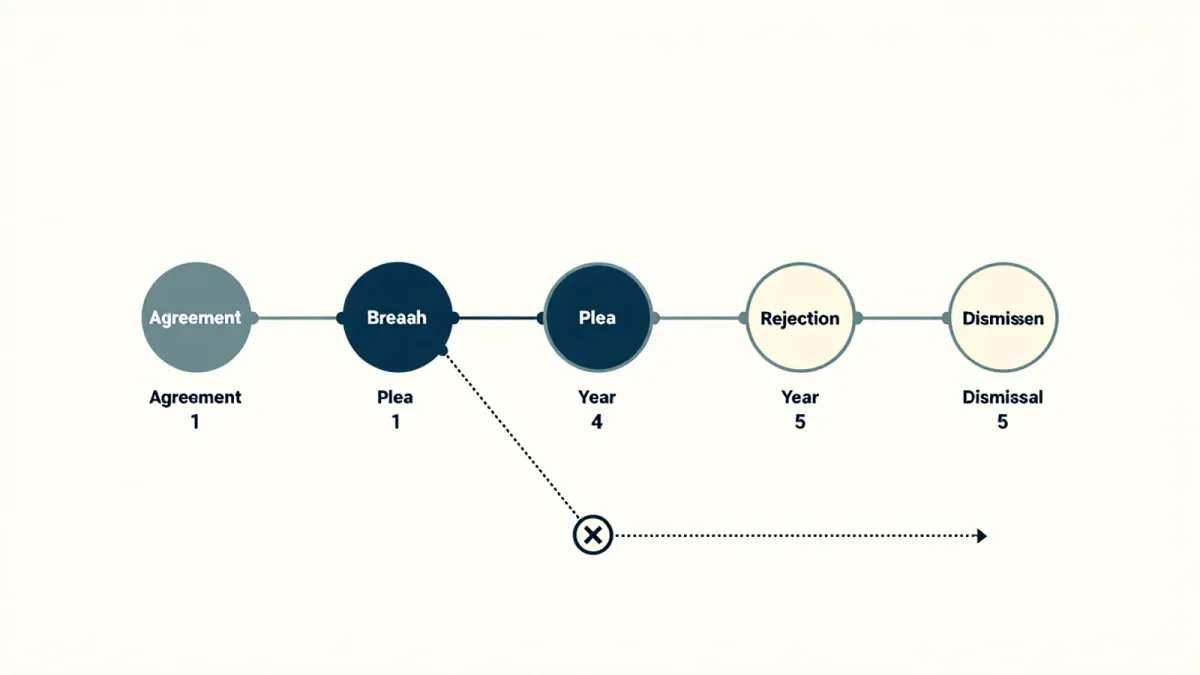
The approval step exists to test voluntariness. Before accepting a guilty plea, the court confirms that the defendant knows what rights are being waived and what the consequences are, the requirement the Supreme Court set out in McCarthy v. United States, as summarized by Cornell. If a deal breaks down, courts treat it like a contract. A defendant who breaches loses the benefit; a prosecutor who reneges can be compelled by the judge to honor the agreement, or the defendant may be allowed to withdraw the plea.
The practical consequence for a defendant is simple: nothing in a plea bargain is final until the judge says so on the record, and nothing in it is enforceable until the plea is entered.
What should a reader take from this?
The evidence in this piece supports three conclusions. First, plea bargaining is not an exception to the American criminal process; it is the process, resolving the overwhelming majority of cases by every estimate in the sources cited here. Second, the bargain is a genuine trade: certainty and a reduced outcome in exchange for waived constitutional rights. Third, the trade happens under unequal pressure, and a guilty plea does not settle the question of innocence the way a jury verdict would.
What remains unknown is the harder question the Judicature scholars posed: compared to what? Any alternative would have to handle the same caseload, and none currently on offer has been shown to do so. Readers who want the surrounding mechanics can see how courts handle pretrial release in our explainer on what bail is and how a judge decides whether to set it, or follow individual prosecutions in our legal section. This article explains process, not outcomes in any specific case, and is not legal advice. Readers following this should also see What bail is, and how a judge decides whether to set it.