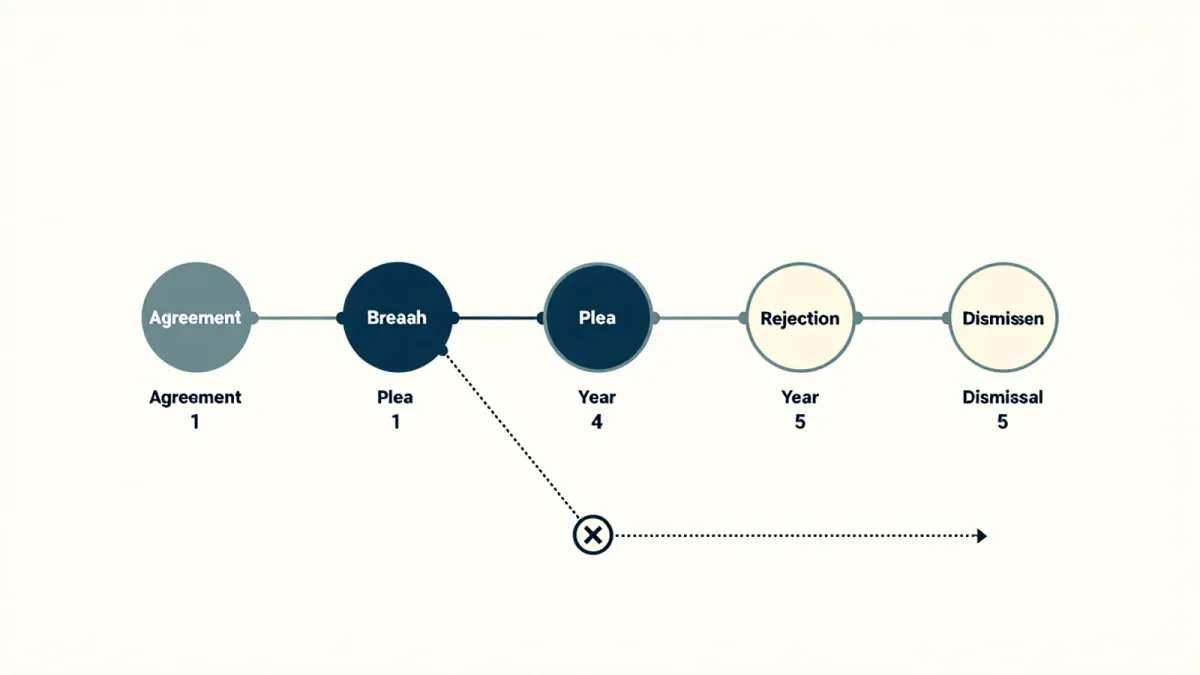
The federal criminal case over the Boeing 737 MAX crashes ended — after several false ends — on November 20, 2025, when Judge Reed O'Connor of the Northern District of Texas dismissed a criminal fraud charge at the Justice Department's request, per the court's order. The case had traveled a remarkable path: a deferred prosecution agreement in January 2021, a finding that Boeing breached it in 2024, a guilty plea agreement the same judge rejected in December 2024, and finally a non-prosecution agreement in 2025 that closed the case without a conviction or a trial.
For anyone studying how the federal government handles corporate crime, the docket is close to a complete syllabus. This article publishes information, not legal advice.
What was Boeing charged with?
The charge was one count of conspiracy to defraud the United States — specifically, the Federal Aviation Administration. Per the January 7, 2021 charging documents, two Boeing technical pilots misled the FAA evaluators who were certifying the 737 MAX's flight manual about the MCAS flight-control software, minimizing what pilots needed to know about a system that could push the plane's nose down. Two crashes — Lion Air Flight 610 in October 2018 and Ethiopian Airlines Flight 302 in March 2019, killing 346 people — followed. The fraud charge did not allege Boeing intended the crashes; it alleged the company deceived the regulator whose approval process was supposed to protect passengers.
Under the deferred prosecution agreement, Boeing admitted the facts, paid a $243.6 million criminal fine, and pledged safety and compliance investments. Prosecution was deferred for three years, with dismissal promised if Boeing complied. No individuals were charged.
What does a deferred prosecution agreement obligate, and did Boeing meet it?
A DPA is a contract in the shadow of indictment: the company avoids conviction by admitting facts, paying penalties, and meeting compliance obligations while prosecutors hold the indictment in reserve. The Justice Department twice extended Boeing's DPA term — first to July 2023, then to July 2024 — and in May 2024 concluded Boeing had breached it by failing to make the promised compliance changes, per the government's court filing, after a door-plug blowout on an Alaska Airlines 737 MAX 9 in January 2024 drew renewed scrutiny.
The breach finding mattered procedurally: it gave the government grounds to seek a guilty plea rather than dismissal, and gave families of crash victims — who had opposed the DPA from the start and had sought to be treated as crime victims entitled to input — a renewed foothold to object.
Why did the judge reject the 2024 guilty plea?
In July 2024, the Justice Department and Boeing reached a plea agreement: Boeing would plead guilty to the conspiracy count, submit to an independent compliance monitor, pay an additional fine up to $243.6 million for a combined $487.2 million, and serve three years of probation, with no trial. Judge O'Connor rejected it on December 4, 2024, citing the parties' use of race- and ethnicity-based considerations in selecting the monitor — a term the court found inconsistent with the government's own obligations, per his order. The rejection was procedural, not a verdict on the merits, but it left the case where it had been years earlier: charged, unresolved, and contested by families who wanted either trial-level accountability or victim-status hearings on the harm.
The episode is a study in judicial gatekeeping: plea agreements, though negotiated by the parties, require court approval, and a district judge may refuse one — rarely exercised, and here consequential.
How did the case actually end?
In May 2025, the Justice Department announced a non-prosecution agreement with Boeing: no guilty plea, in exchange for more than $1.1 billion in payments and commitments, including a roughly $444.5 million fund for families of the crash victims and $455 million in compliance and safety investments, per the department's public statements. Families objected again, arguing the terms shortchanged their rights as crime victims. Judge O'Connor held hearings on the objections and, on November 20, 2025, dismissed the charge at the government's request, per the order, concluding the court's discretion to refuse was limited once the government elected not to proceed.
The end state deserves precise wording: the charge was dismissed — not acquitted, not convicted. Boeing has no criminal conviction from the 737 MAX case; its corporate admission of the 2021 facts stands in the DPA record, and the civil litigation brought by families proceeds separately.
What does the record establish?
The docket documents three propositions. First, corporate DPAs are enforceable in both directions but depend on executive discretion at every stage — extension, breach finding, plea, and finally a decision not to prosecute. Second, victims' procedural rights can shape but not control the outcome: families won hearings and amended terms, and still saw the case end without trial. Third, judicial review of corporate plea deals has teeth; the December 2024 rejection remains, on the public record, the most prominent such refusal in a generation. The 346 people killed in the two crashes were named throughout the filings; the case that was meant to answer for them ended, as DPAs often do, in an agreement rather than a verdict.
Were any individuals charged?
One was. Mark Forkner, Boeing's former chief technical pilot on the 737 MAX program, was indicted in October 2021 on fraud charges tied to the same MCAS descriptions the company was accused of misleading the FAA about — the theory being that he deceived the agency's own pilot-technical group. His trial in the Northern District of Texas ended in March 2022 with acquittal on all counts: jurors concluded the government had not proved he intended to defraud anyone. The acquittal is part of the case's honest ledger. The corporate charge rested on aggregated conduct over years; the individual charge narrowed to one man's messages and proved too thin to sustain intent beyond a reasonable doubt. That asymmetry — corporations convicted through admissions, individuals acquitted at trial — is a recurring feature of corporate prosecutions, and the MAX case documents it in full.
What rights did the victims' families have in the process?
Substantial ones, repeatedly exercised. Under the Crime Victims' Rights Act, families of federal crime victims are entitled to notice, to be heard at proceedings, and to be treated with fairness — and the families of the 346 people killed argued the Justice Department violated those rights by negotiating the DPA and the plea agreement without consulting them. Judge O'Connor agreed at one stage, holding in 2022 that the government had committed a crime victims' rights violation in its DPA handling, and families renewed objections through every subsequent deal. Their lawyers shaped the record at each step even though they could not control the outcome: the 2025 victims' fund and its terms were negotiated against the backdrop of their objections, which continued through the dismissal hearing. The case is now standard reading on what victim participation can — and cannot — force in a corporate prosecution.