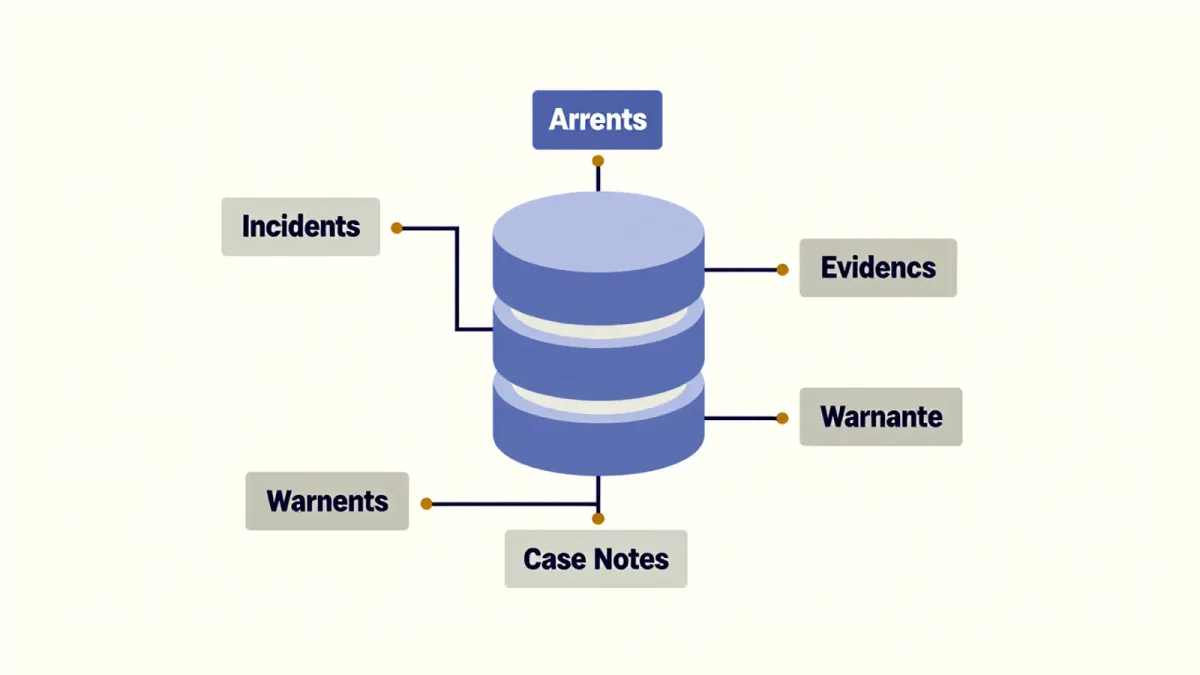
A police records management system is the central database where incident reports, arrests, evidence, warrants and case notes are stored, and since January 1, 2021 the FBI has required agencies to submit crime data through systems capable of the National Incident-Based Reporting System format. Everything the public reads about crime in a city is downstream of how completely officers fill in that database. The software sets the fields; local practice decides whether the fields are accurate.
That is why two departments running the same product can produce data of very different quality. The RMS is less a single tool than a workflow, and the workflow is where the variation lives.
What does a records management system actually store?
A modern RMS is a family of linked modules. The incident module holds the narrative and coded offense data that feed state and federal crime reporting. The arrest module tracks charges, demographics and disposition references. The property and evidence module inventories seized items and chains them to cases. Person, vehicle and location files allow cross-referencing; warrant and civil-process modules track service attempts.
Larger systems also connect to computer-aided dispatch, jail bookings, and body-worn camera platforms, so that a single incident can link a call for service, an officer's report, a mug shot and hours of video. In principle the RMS is the department's institutional memory. In practice, completeness depends on whether the people entering data see that memory as their job.
How does report data get into the system?
The path usually starts in the field. An officer writes a narrative on a mobile terminal or a web portal, enters coded fields — offense, location, time, involved persons — and submits the report to a supervisor for review. Approved reports flow into the database and, for agencies that participate, into state repositories that forward standardized records to the FBI.
Each handoff is a chance for loss. A narrative may describe conduct that the coded fields do not capture; a supervisor may approve reports with missing elements rather than return them; backlogs of unsubmitted paperwork can delay data by months. Independent audits of police records practice have repeatedly found that the interval between an incident and its appearance in official statistics is one of the least standardized parts of American policing.
Why does the same software produce different data quality?
Three variables dominate. The first is entry discipline: whether officers complete every applicable field and whether supervisors reject incomplete work. The second is coding practice: whether local offense classifications track the definitions the state and FBI publish, or drift into local habit. The third is turnover and training, since RMS procedures are learned in-house and depart with departing staff.
Vendor configuration matters too. The same product can be configured so that a field is mandatory in one agency and optional in another. A field that can be skipped eventually is skipped, and no published statistic distinguishes a genuine zero from an empty cell. The table below summarizes the common failure points.
| Data element | Common gap | Effect on published numbers |
|---|---|---|
| Coded offense type | Local classification habits diverge from FBI definitions | Crime trends distorted between jurisdictions |
| Victim and offender demographics | Optional fields left blank | Demographic analyses undercount |
| Property values | Estimates omitted for recovered goods | Monetary loss totals unreliable |
| Clearance codes | Updated late or not at all | Clearance rates shift retroactively |
| Timestamps | Report written days after incident | Hot-spot and time-of-day patterns blur |
Related stories: What redaction software does before police footage is released · What case management software does for prosecutors and defense counsel.
How does NIBRS change what the data shows?
The FBI's shift to the National Incident-Based Reporting System replaced a summary count of a handful of offenses with incident-level records covering dozens of offense categories, plus victim, offender, property and arrestee segments. Per FBI guidance to agencies, an incident report must satisfy dozens of required data elements before it can be accepted, which raised the floor for completeness nationwide.
But the transition also exposed local variation. In the first NIBRS reporting years, a substantial number of agencies submitted partial or noncompliant data, and the FBI published caveats alongside its estimates. Researchers comparing pre- and post-transition figures warn that some trend lines moved because of better recording, not more crime — a distinction the data alone cannot settle.
Who checks an RMS for accuracy, and how?
Checks come from three directions. State reporting bureaus validate monthly submissions against FBI rules and reject records that fail, which catches structural problems but not subtle misclassification. Internal audits sample reports for completeness and timeliness; departments vary widely in whether these audits exist, how often they run and whether their findings are published. External reviews — city auditors, consent-decree monitors, academic partners and inspectors general — produce the deepest accounts, but they are episodic and usually cover a single department.
The result is an accountability gap. Federal reporting verifies that a record exists and passes format rules; it does not verify that the coded offense matches what the narrative describes, or that every qualifying incident generated a report at all. A department can be fully compliant with national reporting while still underrecording systematically, and only a committed local audit would reveal it.
Some states have tightened their own requirements, imposing standardized offense definitions and mandatory training for records personnel. Where those regimes exist, the data is generally sturdier. Where they do not, quality tracks each agency's internal culture, and a reader has little way to know the difference without asking for the audits.
What can a reader do with an imperfect database?
Treat the RMS as a record of what was reported and recorded, not what happened. BJS's National Crime Victimization Survey exists precisely because police counts exclude unreported crime, and comparing the two sources is the standard method for estimating the reporting gap. For local questions, published data quality audits — from city auditors, state bureaus or academic partnerships — are the best guide to how much a given department's numbers can bear.
The software itself is rarely the problem. Records management systems reliably store what they are given. The honest question about any crime statistic is how carefully the department fed it.
For more context, read What case management software does for prosecutors and defense counsel.
For more context, read redaction software.
For more context, read discovery platforms.