Digital forensics tools can copy nearly everything a phone holds — messages, photos, call logs, app data and location history — and the Supreme Court held in Riley v. California in 2014 that officers generally need a warrant before searching a cell phone taken during an arrest. The technology has kept advancing since; the constitutional floor set in Riley has not moved. Understanding what extraction involves, and what courts demand around it, clarifies a recurring dispute in modern criminal cases.
This article explains the methods, the legal requirements, and where extraction products have drawn judicial scrutiny. Nothing here is legal advice; a person facing a search of their device should consult counsel.
What can forensic tools extract from a phone?
Extraction is usually described in three tiers. A logical extraction communicates with the phone's operating system through documented interfaces and copies files, contacts and messages the system will share. A file system extraction reaches deeper, copying records the system holds but does not display. A physical extraction reads the raw flash memory itself, recovering deleted data where it has not been overwritten — the most powerful method and the most technically demanding.
Products sold by commercial vendors, whose capabilities and claims are documented in their own marketing, bundle these methods with parsing software that organizes the result: reconstructed chat threads, timelines, maps of recorded location points. The volume can be startling; a single extraction routinely produces tens of thousands of files. Vendors describe bypassing locked and encrypted devices as well, though those capabilities are claimed rather than independently audited, and the vendors do not publish the technical detail that would allow public verification.
When is a warrant required?
Under Riley v. California, 573 U.S. 373 (2014), police may seize a phone incident to arrest but generally must obtain a warrant before searching its contents, because the quantity and intimacy of data on a phone distinguish it from physical objects in a pocket. The Court rejected the argument that a phone is like any other container. A warrant must describe the device and the data sought with particularity, as courts applying the Fourth Amendment's particularity requirement have repeatedly restated.
Exceptions exist and are litigated constantly: exigent circumstances such as an imminent threat, consent given by the device owner, and searches at the border, where the Supreme Court's doctrine has long permitted broader authority. Consular matters aside, the ordinary case proceeds by warrant. The passcode question — whether a person can be compelled to unlock their own device — is governed by a patchwork of state and appellate precedent that does not resolve uniformly.
How do courts evaluate the extracted evidence?
Extraction produces data; admissibility is a separate gate. Under Daubert v. Merrell Dow Pharmaceuticals, 509 U.S. 579 (1993), federal courts act as gatekeepers for expert and technical evidence, asking whether the method is testable, subjected to peer review, known to have error rates and generally accepted. State courts apply Daubert or the older Frye standard. Extraction tools have generally been admitted, but the challenges shape practice.
Defense challenges have focused on several recurring points: whether the parsing software correctly attributes messages to individuals rather than merely to accounts; whether deleted-data recovery is reliable enough to support claims about what a person saw or sent; and whether the vendor's refusal to disclose internal tool code frustrates cross-examination. Some judges have excluded or limited testimony where the examiner's report went beyond the underlying data, and appellate opinions in several states have urged caution in how extraction findings are described to juries.
| Requirement | Source | What it demands |
|---|---|---|
| Warrant for search | Riley v. California, 2014 | Judicial authorization before searching a seized phone |
| Particularity | Fourth Amendment doctrine | The warrant describes device and data scope |
| Reliability screening | Daubert / Frye | Method shown testable, reviewed, with known error rates |
| Disclosure and testing | Discovery rules | Defense access to underlying data and methods |
Who performs extractions, and how is the work documented?
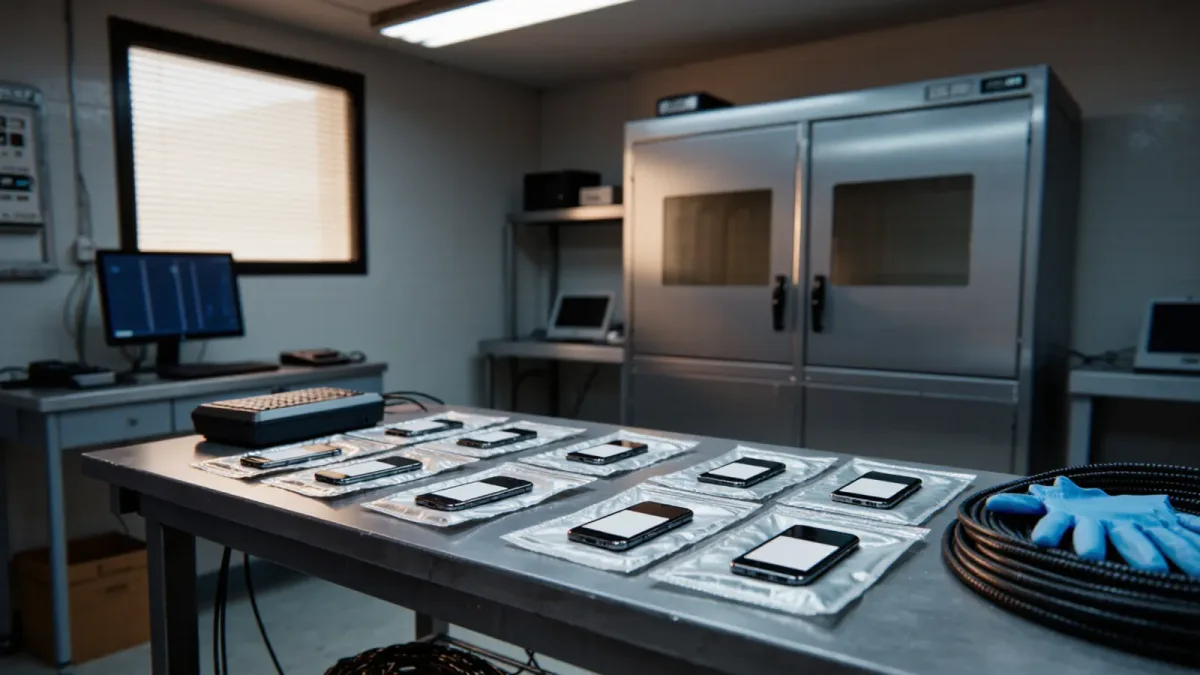
Extractions are usually performed by certified examiners at regional or state crime laboratories, by dedicated detectives in larger agencies, or by contract laboratories when local capacity is short. Accredited laboratories follow documented procedures derived from National Institute of Standards and Technology and NIJ guidance: the device is photographed, its condition recorded, the extraction method logged with the tool version, and the resulting files hashed so any later alteration can be detected.
Documentation quality varies outside accredited settings. Cross-examination in extraction disputes often turns less on the software and more on the examiner's notes: whether the tool version was recorded, whether the hash values were preserved, whether the report distinguishes what the device contained from what the software inferred. That distinction, more than any single feature of the tools, is what the published guidance exists to protect.
What are the technology's limits?
Extraction is not omniscient. Encryption without an available bypass blocks access entirely; modern default device encryption means some seized phones yield nothing. Cloud data usually lies outside the device and requires separate legal process to the service provider. And the interpretation layer — the mapping of raw records into human-readable claims — is where most documented errors live, since database schemas change with every operating system update and the parser must keep pace.
Examiners and vendors describe updates to their tools continuously, but the correctness of those updates is checked mainly by the tool's users and by whatever litigation forces scrutiny. The gap between what a tool displays and what the underlying data proves is the recurring theme of the case law.
What should a reader take from an extraction report?
Treat the report as one machine's organized view of records the phone stored — an account with provenance, not a transcript of intent. The National Institute of Justice maintains published guidance on mobile device forensics for laboratories, emphasizing documentation, validation and handling, and those guidance documents are the best public window into accepted practice. Where a case turns on what a phone shows, the honest questions are the legal ones: was the search authorized, and does the method support the claim being made from it.