Probabilistic genotyping is software that computes the weight of DNA evidence from complex mixtures — samples containing several people's DNA — by comparing the likelihood of the observed data under alternative hypotheses, and the reference point for its court admissibility is the 2016 report of the President's Council of Advisors on Science and Technology, which concluded that only fully continuous methods had then been validated adequately. Courts applying Daubert have since required each laboratory to show validation before results reach a jury.
The software is now routine in crime laboratories and contested in courtrooms, and both facts trace to the same feature: its output is a statistical weight produced by a program most jurors cannot inspect, on samples whose interpretation once required an analyst's judgment call.
What problem does probabilistic genotyping solve?
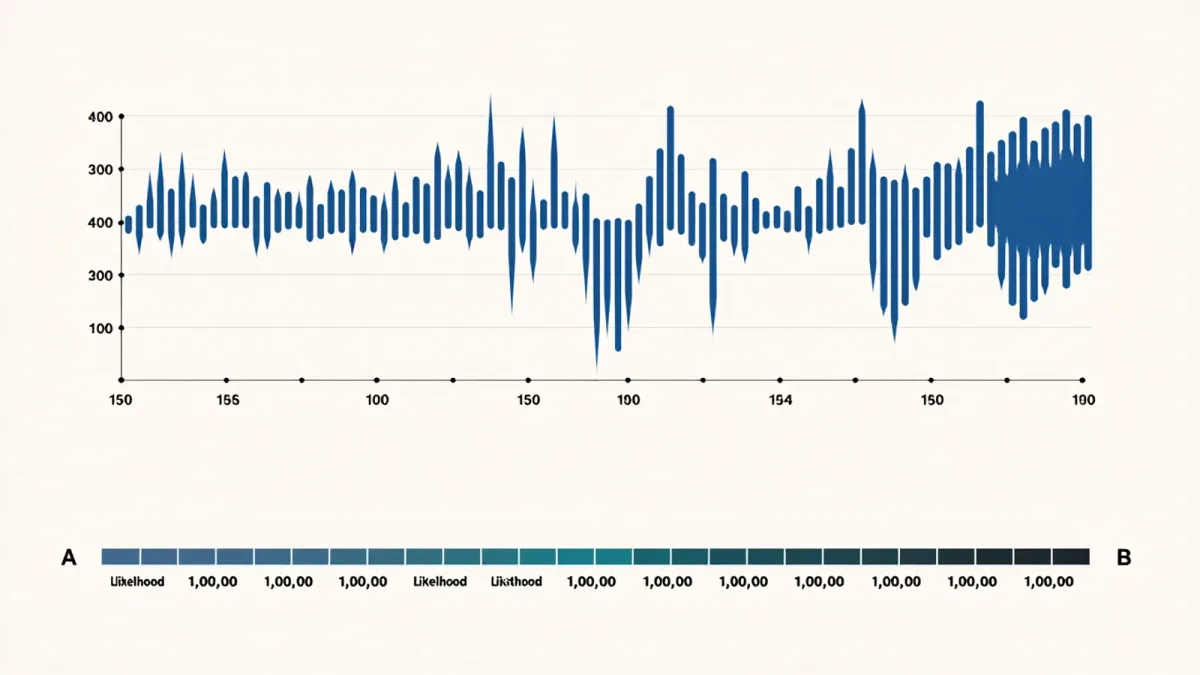
Mixtures are common: a grip, a garment, a door handle routinely carries DNA from two or more people, sometimes in tiny and degraded quantities. The older approach, called combined probability of inclusion, asked whether a person could be included as a contributor and generally worked only on simpler mixtures. With three or more contributors, or a contributor at low levels, analysts had to make subjective judgments about which peaks in the electropherogram represented real alleles and which were noise or artifacts.
Probabilistic genotyping replaces those judgments with a statistical model. The software, whose best-known implementations are used by public laboratories and by private practice, models peak heights, stutters and drop-out probabilistically, considers large numbers of contributor hypotheses and outputs a likelihood ratio: how much more probable the evidence is if the person of interest is a contributor than if they are not. The output is a number, not a certainty, and its meaning depends entirely on the hypotheses compared.
What did the PCAST report change?
The 2016 PCAST report reviewed the scientific foundation of feature-comparison methods, including DNA mixture analysis, and drew a line between two generations of software. It found that older semi-continuous methods lacked adequate validation studies establishing false-positive rates, while the newer fully continuous methods had the beginnings of a proper validation record. The report recommended rigorous validation before courtroom use — a standard that trial courts have cited repeatedly in admissibility hearings since.
Laboratories responded by conducting and publishing internal validation studies. The FBI's published validation of its laboratory's use of STRmix, completed in the years after the report, reported successful performance across a range of mixture conditions, and public laboratories in many states produced their own internal validations tailored to their instruments and protocols. Validation, not the software's existence, became the admissibility battleground — exactly as PCAST intended.
What do courts actually require?
Under Daubert, the proponent of the evidence must show the method is testable, peer-reviewed, has known error rates and enjoys general acceptance. For probabilistic genotyping the hearings typically examine the laboratory's validation study, the software's documentation, published error-rate measurements from controlled studies and the analyst's proficiency testing. State courts applying the older Frye standard ask whether the method is generally accepted in the relevant scientific community, which the published validation literature largely supplies.
Defense challenges have raised recurring arguments: that source code is not fully disclosed for cross-examination; that validation studies used favorable mixture conditions; that likelihood ratios can be misstated to juries as probabilities of guilt; and that software updates change results in ways that outpace validation. Courts have mostly admitted the evidence while managing these concerns — ordering source code review under protective orders, requiring careful instruction on what a likelihood ratio means and admitting the underlying data so the defense's own experts can re-run it.
| Requirement | Source | What satisfies it |
|---|---|---|
| Reliability screening | Daubert / Frye | Published validation studies, error rates |
| Laboratory-specific validation | Post-PCAST practice | Internal validation on local instruments |
| Disclosability | Discovery rules | Data and documentation for defense experts |
| Correct statement of meaning | Evidence rules | Likelihood ratio explained, not conflated with guilt |
What do independent reviews say about performance?
The National Institute of Standards and Technology has conducted the field's broadest independent examinations. A NIST scientific foundation review of DNA mixture interpretation, published in 2021, documented gaps in written guidance and found that in interlaboratory exercises, laboratories did not always reach the same results on the same data — a finding about the human and laboratory system around the software as much as about the software itself. NIST's work has not condemned the methods; it has emphasized that performance depends on training, parameters and documentation, and that the field's own studies remain limited in scope.
That nuance matters for how a reader should treat any single number. A likelihood ratio is reproducible only within the conditions under which the system was validated. Independent reviews consistently return to the same recommendation: laboratories should publish their validation details, document their parameters and expect their interpretations to be checked by others.
Who runs the software, and who checks it?
Public crime laboratories perform most probabilistic genotyping, under analysts who must pass proficiency testing and whose interpretations are peer-reviewed before reporting. Defense experts can, in principle, re-run the analysis on the same data, since courts increasingly order production of the underlying files along with the software parameters used. Whether that re-analysis actually happens depends on resources: expert review of a mixture analysis is expensive, and indigent defendants depend on courts funding the work.
The software vendors sit in an unusual position. Their programs are proprietary, disclosed to courts and experts under protective orders rather than published outright. Courts have generally accepted this arrangement, though critics argue that scientific transparency normally means methods a community can freely examine. The compromise that has emerged — data produced, code inspected, parameters documented — is a legal settlement of what is ultimately a scientific norms question, and it is revisited whenever a new version changes results in a pending case.
What should a juror or reader take from a likelihood ratio?
A likelihood ratio of, say, several million does not mean the person is guilty; it means the DNA data is much more probable if that person contributed than if an unrelated person did. Whether the person contributed, and whether the offense occurred, are separate questions the statistics do not answer. Courts and commentators have repeatedly corrected testimony that blurred the distinction, and the National Institute of Justice publishes guidance on presenting DNA statistics without overstating them.
Probabilistic genotyping has made complex mixtures usable as evidence in cases where older methods stayed silent. Its reach beyond those validated conditions — and the transparency of the programs doing the computing — remain the live questions, argued one admissibility hearing at a time.