On January 1, 2026, hundreds of state laws passed in 2025 legislative sessions took simultaneous effect, including large criminal-justice packages: California's judiciary reported that nearly 800 new laws would take effect that day statewide, per the California Courts Newsroom, while Illinois removed the time limit for prosecuting involuntary servitude offenses under House Bill 2602, per Illinois Legal Aid Online. The first-of-January mass effective date is the standard rhythm of state government, and it changes what police, prosecutors, and judges do the same morning.
This article describes the laws and their effective dates; it is information, not legal advice.
Why do so many laws start on the same day?
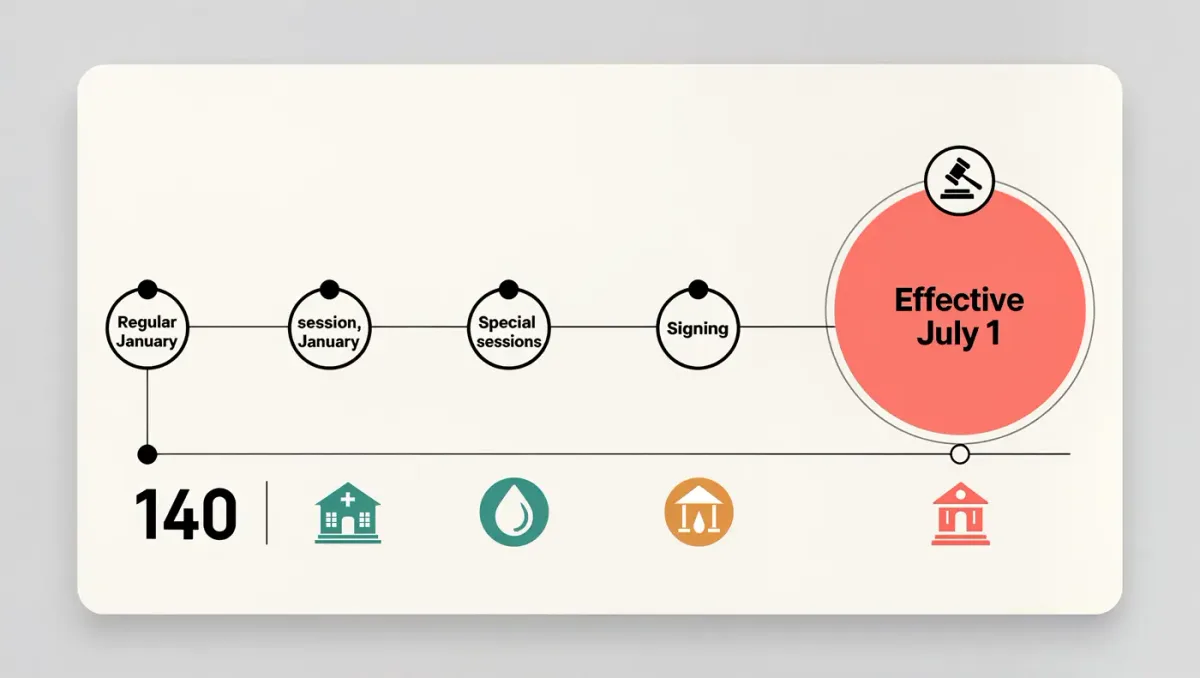
Most state constitutions and statutes give acts a default effective date — often the first of January, or a fixed period after signature. Legislatures can accelerate or delay specific laws with an urgency clause or a stated date, which is why a handful of 2025 laws took effect mid-year while the bulk arrived together. For court administrators, the mass date is an operations event: jury instructions, forms, and case-management systems must be updated overnight.
The practical consequence for defendants is that the applicable law depends on the date of the conduct, not the date of the charge — a principle that keeps legislatures from applying new penalties retroactively.
What kinds of changes took effect in 2026?
Per the California Courts Newsroom's summary, the state's package touched court operations and criminal procedure broadly, including relief-eligibility expansions for felony convictions and juvenile commitments noted by the Administrative Office of the Courts. Per Illinois Legal Aid Online, House Bill 2602 eliminated the statute of limitations for involuntary servitude offenses, a category covering forced labor and trafficking-like conduct.
National trackers of 2026 legislation, per the National Association of VOCA Assistance Administrators' roundup, showed states moving in opposite directions at once: some weighing repeat-offender sentence enhancements, others expanding diversion programs. That divergence is normal; criminal law is primarily state law, and effective dates expose the differences more visibly than any national debate.
What does the process do with a new law next?
After the effective date, three things follow. Trial courts apply the statute to conduct occurring on or after the effective date and begin building case law on its interpretation. Prosecutors and defenders issue training bulletins on changed elements and procedures. And appellate courts receive the first challenges — to vagueness, to retroactive application, to sentencing structures — which take a year or more to resolve.
How should readers evaluate claims about a new state law?
Check three things in the record: the effective date printed in the act, whether it applies to conduct before that date, and whether any court has already construed it. A statute's text is only its first document; the operative meaning settles as rulings accumulate. In early 2026, most of the January 1 laws were still in that first interpretive year.