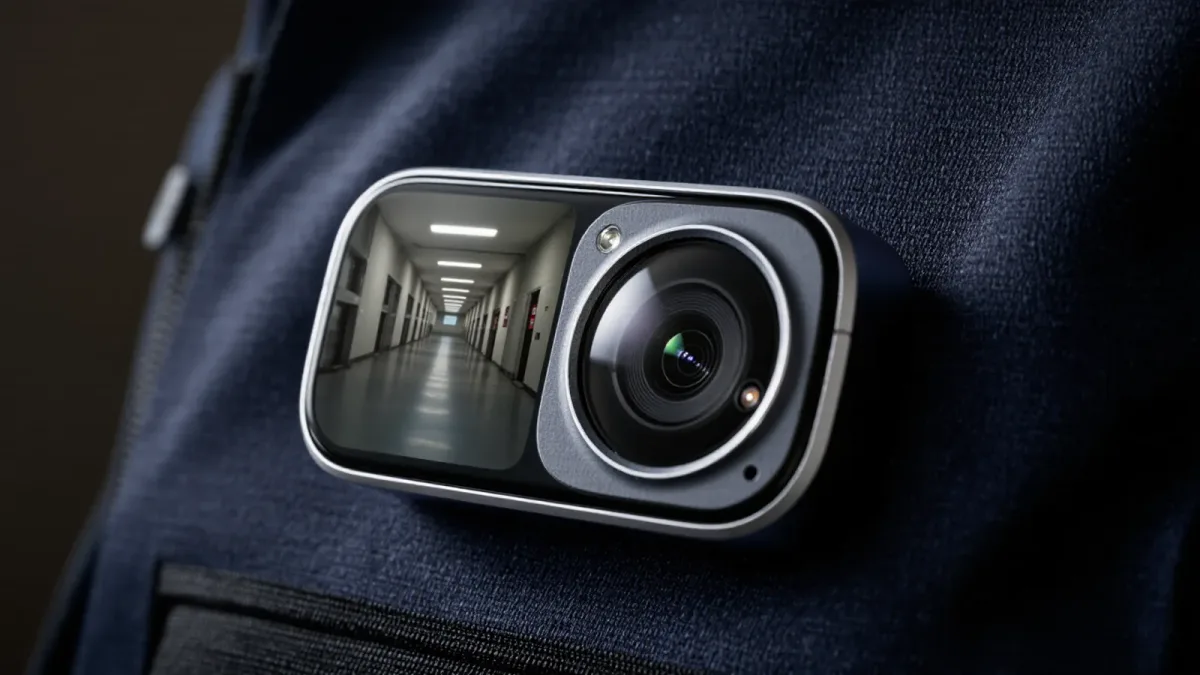
Body-worn camera footage becomes public when a jurisdiction's public records law, a court, or the agency itself decides to release it — and the rules vary so widely that identical incidents can produce a video within 45 days in California and require a court order in North Carolina. California's 2018 law, AB 748, requires release of footage from critical incidents within 45 days unless disclosure would interfere with an active investigation. North Carolina's 2016 statute does the opposite: footage is not a public record at all, and only a Superior Court judge can order it released. The camera records everything; the law decides what anyone sees.
This article explains the routes by which footage reaches the public, the state rules that govern them, and the practical barriers that persist even where the law favors release. It publishes information, not legal advice.
What actually happens to footage after an incident?
Officers upload video to an evidence management system at the end of a shift. The footage is classified — evidence, non-evidence, or administrative — and placed under an investigative hold when a critical incident triggers one: an officer-involved shooting, an in-custody death, a serious-force case. Holds are reviewed by prosecutors, who may restrict release while charges or investigations are pending. Only after those decisions does a public records request, a subpoena, or a proactive release move the file outward. At each step, a custodian — the police department's records unit or a city attorney — makes a disclosure decision under a specific legal standard, and that standard is where jurisdictions diverge.
How did cameras end up on officers in the first place?
The spread followed documented events rather than mandates. After the 2014 death of Michael Brown in Ferguson, Missouri, where no officer video existed of the encounter, federal grant money through the Bureau of Justice Assistance funded tens of thousands of cameras, and large departments adopted them city by city. By the late 2010s, major agencies including the New York Police Department had equipped patrol officers, and the Justice Department's grant evaluations reported rapid adoption nationwide. But the same pattern that spread the cameras — local choice, local funding — left disclosure rules to state legislatures, which is why a recording device worn identically in Raleigh and Sacramento can be governed by opposite legal regimes. The camera policy question moved, over about five years, from whether officers would record to who is allowed to watch.
Which states treat footage as public, and which do not?
The states sit on a spectrum. California and a handful of others put footage squarely in the public records regime, with statutory deadlines for critical incidents. Many states leave footage to general public records law, subject to investigative-exemption arguments. Others classify it categorically as non-public: North Carolina's House Bill 972, passed in July 2016 after the shooting of Keith Lamont Scott in Charlotte, requires a petition to Superior Court with a judge weighing disclosure — and it exempted footage retroactively. New York's 2020 repeal of Civil Rights Law section 50-a, which had long shielded misconduct records, followed the killing of George Floyd and brought that state toward disclosure. Washington's 2021 public records amendment, meant to protect crime victims' privacy, instead slowed footage release so severely that the state's own records officers reported massive backlogs, and the legislature amended it in 2022.
| State example | Rule, per statute | Practical effect |
|---|---|---|
| California (AB 748, 2018) | Critical-incident footage public within 45 days unless release would harm an active investigation | Routine, deadline-driven release |
| North Carolina (2016) | Footage not a public record; court order required | Release only through a Superior Court petition |
| New York (2020 repeal of 50-a) | Misconduct records and related footage disclosable | Opened decades-closed files to requesters |
| Washington (2021, amended 2022) | Victim-privacy exemptions broadened, then narrowed | Severe release backlog, then partial recovery |
Related stories: What use-of-force reporting requires, and where the gaps remain · What de-escalation policies require, and how compliance is measured.
Why do departments release some videos proactively?
Some agencies publish critical-incident footage on their own schedule, typically within a few weeks, after showing it to the family of the deceased. Departments including those in Las Vegas and Tucson adopted proactive-release policies in the mid-2010s, reasoning that early release, with clarity about what the video does and does not show, reduces speculation. Police officials caution in public statements that raw footage is one account of an incident, not a verdict, and that partial camera views shape early public impressions before any investigation concludes. Proactive release remains discretionary — no federal rule requires it, and the practice concentrates in large agencies.
Who is redacted or exempted, and on what grounds?
Even where footage is public, custodians blur or withhold for documented reasons: faces and identities of witnesses, minors, and victims; footage inside medical settings, private homes, or schools; content that would reveal surveillance techniques or endanger an officer. Automated redaction software handles faces and objects; the legal judgment about what to redact stays human. Requesters can challenge withholdings in court, and litigated cases — such as the California Supreme Court decisions applying AB 748's active-investigation exception — have defined how long an investigation may justify delay. The exemption is the battleground: few agencies claim footage is categorically secret, but many claim every incident is still active.
What do the deadlines mean in practice?
Deadlines move files faster, but the record shows slippage is common. In California, news organizations and civil rights attorneys documented agencies invoking the active-investigation exception repeatedly in high-profile cases, releasing footage months past 45 days. In court-order states, the interval runs longer: North Carolina petitions in the 2016-2020 period produced releases in some cases and denials in others, with timelines driven by litigation rather than any statutory clock. The measurable difference between regimes is therefore not whether footage ever emerges — usually it does — but how many months pass, and whether the public sees it before the case resolves.
What is changing the picture now?
Two developments press toward openness. First, more prosecutors' offices release critical-incident footage themselves as part of their public case files, bypassing the police records function. Second, a number of states have adopted statutes modeled on California's deadline approach since 2020. The counterpressure is privacy litigation and victims' advocacy, which courts have weighed seriously, per published opinions in several states. The likely steady state is the one the record already shows: footage is becoming more public over time, but at a pace set by statute and by whoever holds the file.
For more context, read What de-escalation policies require, and how compliance is measured.
For more context, read civilian oversight police.
For more context, read use of force reporting.