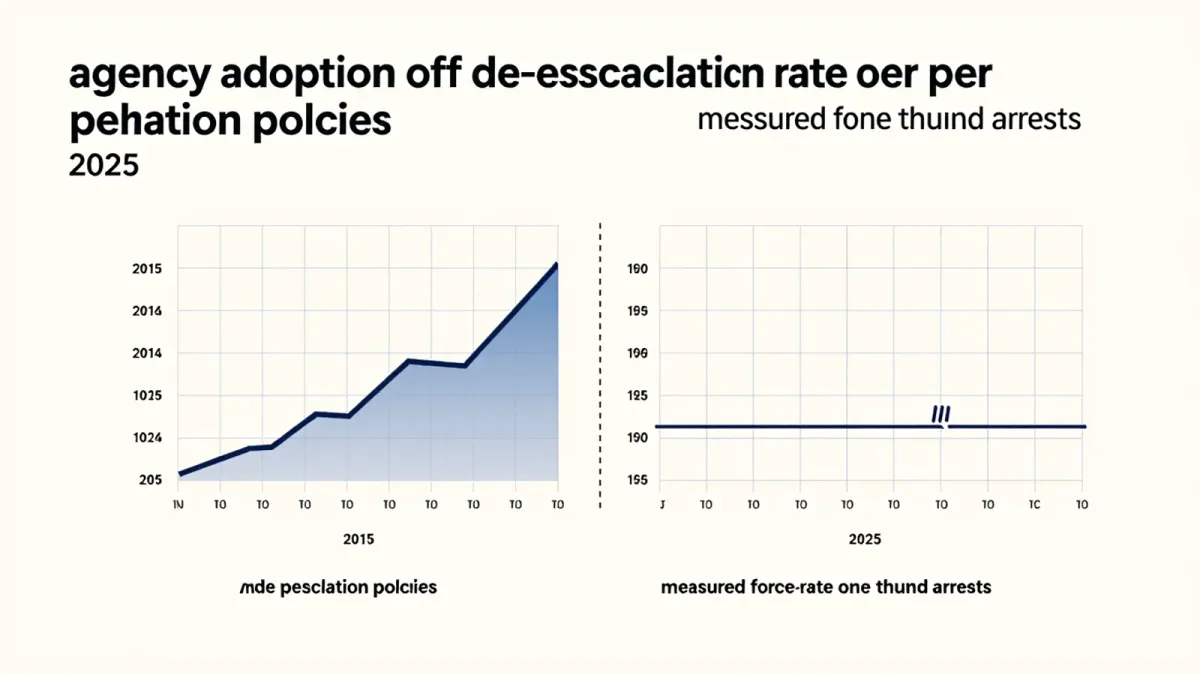
A de-escalation policy requires officers to slow an encounter down when feasible — time, distance, cover, verbal persuasion — before resorting to force, and compliance is measured the way the force itself is documented: through use-of-force reports, supervisor reviews, and department-level force rates compared against arrests. Adoption is now near-universal among large agencies: per the Police Executive Research Forum's 2020 survey of 282 agencies, the large majority had revised their use-of-force policies after 2014, and a 2020 federal executive order tied some grant funding to certified de-escalation policy, per the White House order of May 2020. The policies changed the paperwork quickly. The street-level question — whether force declines — is a measurement problem the data is only partly equipped to answer.
This article explains what these policies require, how departments verify compliance, and what the measurable record shows. It publishes information, not legal advice.
What does a de-escalation policy actually require?
Modern policies share a documented set of elements. They define de-escalation as actions and communication intended to stabilize an encounter and reduce the immediacy of a threat. They require officers to use time, distance, and cover — creating space rather than closing on a subject — when feasible, and they state that de-escalation techniques should be used before force where circumstances reasonably allow. The critical legal phrase is feasibility: the policy does not require de-escalation where it would place the officer or others in danger, a limit written into model policies and reflected in state statutes such as California's 2019 use-of-force law, AB 392, which uses the same conditional. Policies also typically require officers to intervene when another officer uses excessive force and to render medical aid — requirements that moved from reform wish lists into mainstream policy language after 2020.
How did so many departments adopt them so fast?
Three forces converged. Training infrastructure: the Police Executive Research Forum published its Integrated Communications, Assessment, and Tactics training guide in 2016, built with input from major agencies, and ICAT training spread through the profession. Litigation and consent decrees: agreements in Seattle, New Orleans, and Chicago require de-escalation as policy, with monitors auditing compliance. And funding conditions: Executive Order 13912 of May 2020 made credentialing — including an acceptable de-escalation policy — a condition for certain federal grants, per the order. The 8 Can't Wait campaign pushed a parallel narrative, claiming its eight policy measures were associated with a 72 percent reduction in police killings; that figure drew published criticism from researchers who found the underlying analysis methodologically weak, per the scholarly responses in 2020, and it illustrates the gap between policy counting and measured outcomes.
| Policy element | What it requires | How compliance shows up in data |
|---|---|---|
| De-escalation duty | Time, distance, cover before force, when feasible | Force per arrest; narrative quality in force reports |
| Proportionality | Force matched to threat | Supervisor findings on force reviews |
| Duty to intervene | Officers stop excessive force by others | Intervention reports; rare and notable when documented |
| Medical aid | Aid rendered after force | Aid documentation in use-of-force files |
How is compliance actually measured?
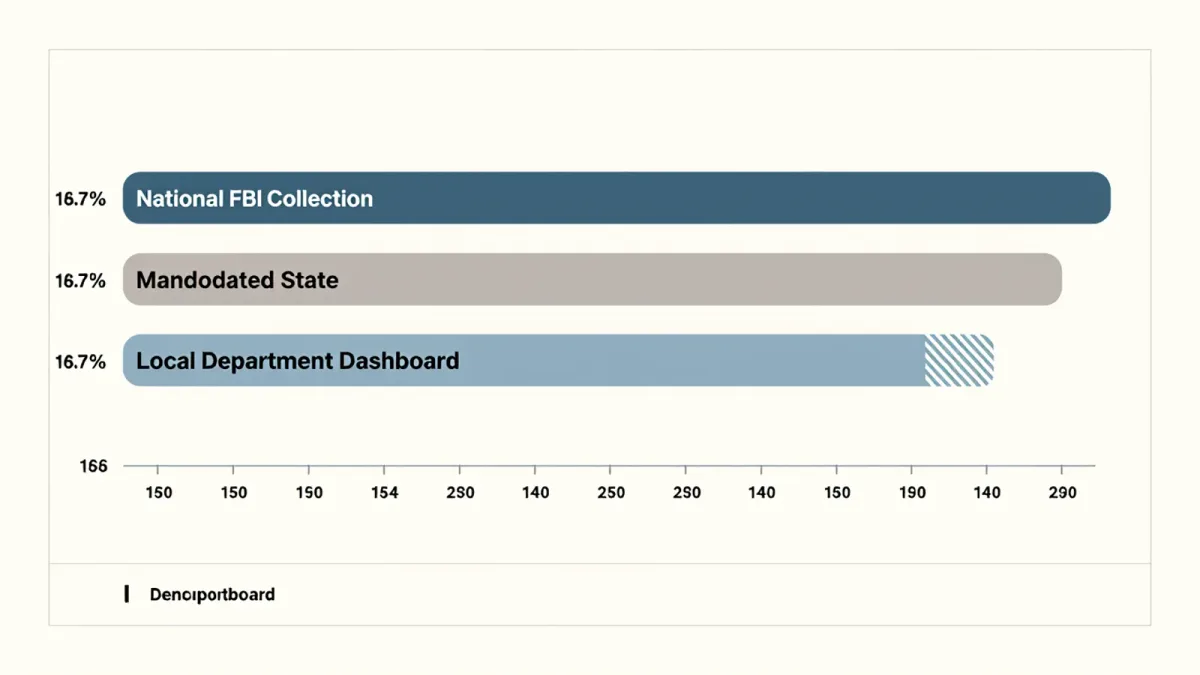
At the incident level, compliance is inferred, not observed. Supervisor review of a force report asks whether alternatives were feasible — a judgment made from the report, camera footage, and witness accounts. At the department level, the standard metrics are force rates per arrest or per 1,000 contacts, serious-injury force counts, and complaint volumes, tracked over time and, in decree cities, audited by monitors. Dallas's policy, adopted in 2017 after its own review of officer-involved shootings, required de-escalation before force where possible; the city's published force data in subsequent years showed declines in force incidents alongside the policy change, though the city did not isolate the policy's effect from training and staffing changes. Seattle's decree-era data, studied by university researchers, showed force declining without crime rising — the pairing reformers cite most, and one the monitoring record attributes to the decree's combined requirements, not to the policy text alone.
What does the evidence say about outcomes?
The strongest published evidence is on training rather than policy text. A 2020 randomized evaluation in Arizona, published in the Proceedings of the National Academy of Sciences, found that officers who received intensive scenario-based de-escalation training generated fewer complaints and use-of-force reports than a control group in the following two years — the clearest experimental result the field has. Policy adoption without documented training and supervision has a weaker record: per monitoring reports in several decree cities, officers could recite the duty to de-escalate while force reviews still found its absence in encounters. The lesson in the record is consistent — policy is the floor, training builds the behavior, supervision verifies it.
Why is feasibility the contested part?
Because it converts every compliance dispute into a judgment call. Officers argue the circumstances did not allow time or distance; reviewers disagree from the same footage. Arbitration decisions and court opinions have generally deferred to officers' stated perception of danger, which means the feasibility clause functions as the policy's pressure valve. Departments that measure compliance well publish the disagreement: Seattle and Chicago dashboards record force reviews where de-escalation was assessed as feasible or not, making the judgment visible rather than buried. Where that disclosure is absent, per the public record, compliance claims rest on aggregate force rates — which move for many reasons and prove little about any single policy.
Another documented measurement gap is arrest denominators. Force rates per arrest can fall because arrests fell — a shift toward citations, for instance, during a reform period — while force per encounter stays flat. Cities that publish both denominators make the distinction checkable; most do not, per a review of department dashboards, and monitoring reports have flagged the same ambiguity when evaluating decree compliance. Anyone reading a department's compliance claim should first ask what number the rate was divided by.
What would demonstrate compliance, per the record?
The documented gold standard is a combination: mandatory scenario-based training with completion records; force rates published per arrest, disaggregated by incident type; supervisor reviews that record feasibility judgments; and audits sampling camera footage against force reports. Departments under consent decrees have built most of that apparatus, and their monitoring reports are the public record's best source on whether de-escalation is practiced rather than recited. For everyone else, the honest answer per the published data is that adoption is verified and compliance, in most places, is not yet measured.