Use-of-force reporting requires officers to document the force they use — type, level, injuries, and circumstances — in incident-level records that supervisors and, in many states, state agencies collect. The FBI's National Use-of-Force Data Collection began publishing national figures in December 2022, years after its 2019 launch, because so few agencies participated that the bureau had withheld public release; fatal police shootings have remained roughly at 1,000 per year since 2015, per The Washington Post's running database, a count built precisely because official reporting lagged. The mandates are real. The gaps are too.
This article explains what the reporting rules require, which records exist at each level of government, and where the documentation still falls short. It publishes information, not legal advice.
What are agencies legally required to report?
There is no single federal mandate binding every agency. The FBI's program, established after the 2014 death of Michael Brown in Ferguson, asks contributing agencies to report all use-of-force incidents involving serious injury or death and the discharge of a firearm at a person, whether or not anyone is hit. Participation is voluntary, and the bureau set an 80 percent coverage threshold for officer population before publishing. In the first release, covering 2021 data, participating agencies represented well under that threshold — the FBI reported participation covering roughly 60 percent of sworn officers at the time of publication, and by later releases the share had grown but never uniformly across states. Separately, the Death in Custody Reporting Act requires states receiving certain federal funds to report deaths in custody, and a 2020 executive order tied some federal grant money to use-of-force credentialing, per the White House order of May 2020.
What do department-level policies require?
Most departments require a written report for any force above a defined threshold — typically anything beyond compliant handcuffing — submitted before the end of the officer's shift, reviewed up a chain of supervisors, and logged in a force tracking system. Consent decrees in cities including Chicago, New Orleans, and Seattle hardened these requirements further, mandating reporting of threatened force, of each application of force rather than a summary, and supervisor response at the scene. The resulting records feed internal review boards and, in a growing number of cities, public dashboards. Seattle's use-of-force dashboard and Chicago's Invisible Institute database are among the systems that publish incident-level force data drawn from these internal records.
What happens to a force report after it is filed?
Inside a department, the report travels through supervision review: a sergeant responds to the scene or reviews the file within days, use-of-force reviewers or an inspections unit check it for policy compliance, and the findings — in policy, out of policy, or within policy but improvable — are recorded. That internal trail matters more than the federal data for accountability, because it is where patterns in an individual officer's file first become visible. It is also where the public record usually ends. Outside the FBI's national aggregates and the dashboards a handful of cities maintain, force review outcomes are rarely published, and researchers studying departments under court supervision have repeatedly noted that the hardest requirement to meet is not filing reports but documenting that supervisors actually reviewed them.
What do the published numbers show?
The FBI's national release for 2021 — the first public dataset — reported just over 61,000 serious-injury or death use-of-force incidents from participating agencies, alongside roughly 500 justifiable law enforcement homicides counted for that year by reporting agencies, figures the bureau itself flagged as partial. The Washington Post's independent database of fatal police shootings, compiled from news reports, public records, and databases, has logged about 1,000 fatal shootings in each year from 2015 through 2024. BJS arrest-related death counts, built from state reports, have historically captured fewer deaths than independent tallies, a gap researchers attributed to incomplete participation rather than to actual declines.
| Data source | What it counts | Coverage limitation |
|---|---|---|
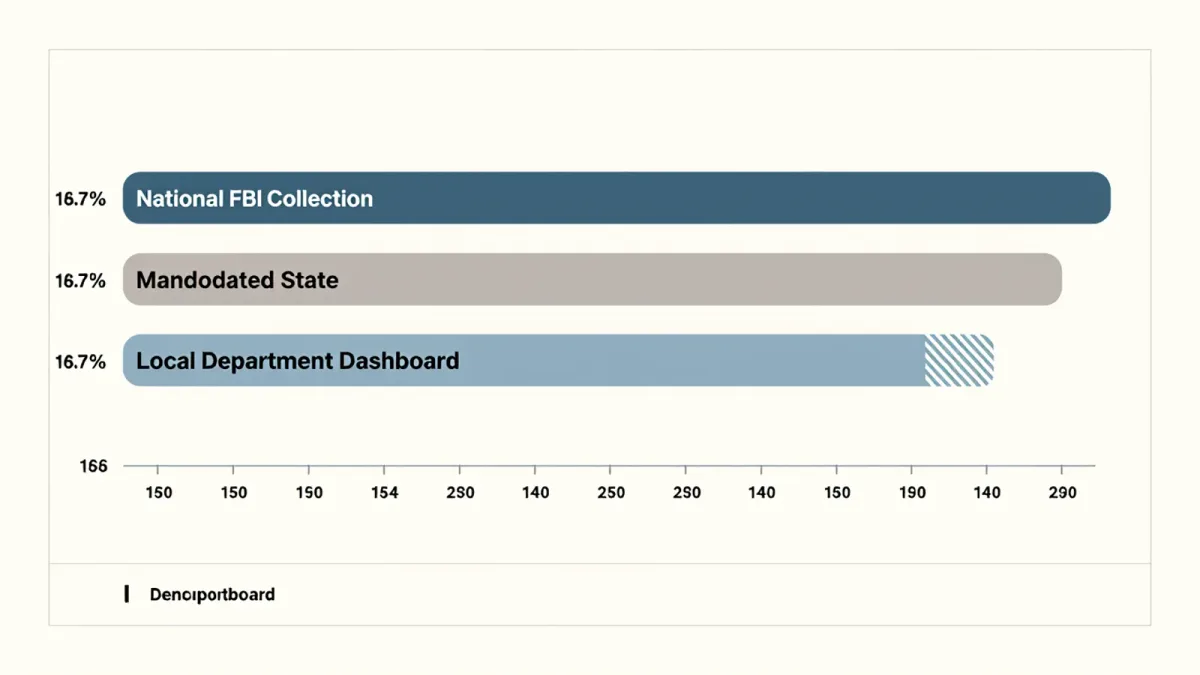
| FBI National Use-of-Force Data Collection | Serious injury or death force; firearm discharges | Voluntary participation; under 80% officer coverage at first release |
| The Washington Post database | Fatal on-duty police shootings | News-based compilation; not an official count |
| BJS arrest-related deaths program | Deaths during or after arrest | Historically undercounted, per BJS methodology reports |
| Local department force logs | All reportable force, including minor | Definitions and thresholds vary by agency; rarely public |
Where do the gaps actually come from?
Three gaps recur in the research record. First, participation: the federal system is voluntary, and large states including Florida and, for years, California did not contribute complete agency sets to the FBI program in its early releases. Second, definition: agencies disagree on what counts as reportable force — whether pointing a firearm, a police dog bite, or soft-hand techniques must be logged — which makes cross-city comparison unreliable. Third, completeness within reports: studies of force files under consent decrees have found missing elements such as injury descriptions or supervisor reviews even where a report exists. None of these gaps is a reporting failure in a single place; they compound.
How do state laws change the picture?
A number of states now mandate their own collection. California's 2015 law, AB 71, requires every agency to report all incidents of force causing serious injury or death to the state Department of Justice, and California began publishing agency-level data in 2019. Connecticut and a few others require reporting for accreditation or funding purposes. State mandates close the participation gap for their own states but deepen the national fragmentation: a researcher comparing Minneapolis to Memphis is comparing different reporting regimes entirely. Per BJS commentary on its own custody-death program, the absence of a mandatory, uniform federal baseline remains the central structural weakness of the field.
What would fuller reporting change?
Complete incident-level data would let researchers measure what the field can currently only estimate: which training, supervision, or dispatch practices correlate with force, and how force varies across similar calls. The FBI's data team has said fuller participation would allow jurisdiction-adjusted comparisons. Until then, the documented record rests on a partial federal system, state patchworks, and independent tallies, each useful and each incomplete in a documented, attributable way.