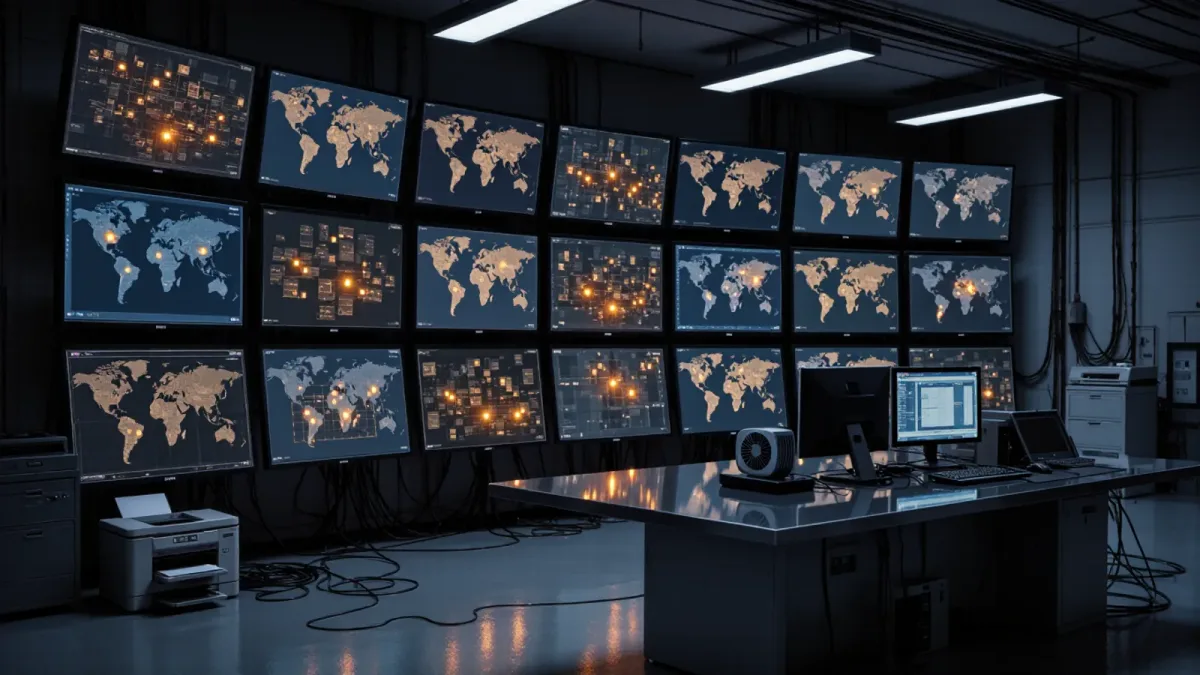
A crime analysis unit is the team inside a police department that reads the department's own data — calls for service, reports, arrests, and increasingly camera and sensor feeds — to find patterns: a string of robberies with one method, a block where burglaries cluster, a series worth linking across districts. The work is now standard in large agencies and predates the current surveillance debate by decades: the New York Police Department's CompStat meetings, launched in 1994, institutionalized the pattern review that analysis units feed. The privacy questions come from the unit's newer inputs — license plate readers, commercial data brokers, geofence records — which collect on everyone in the data's path, charged or not.
This article explains what analysis units actually do, where their data comes from, and what the documented record shows about both their effectiveness and their privacy costs. It publishes information, not legal advice.
What does a crime analysis unit actually produce?
The products are operational documents: pattern bulletins linking offenses by method and geography, hotspot maps directing patrols, weekly CompStat slides ranking activity by district, and case-support packages for investigators working a series. The work divides, in the profession's own taxonomy, into tactical analysis on recent cases, strategic analysis on long-term trends, and administrative analysis on workload and performance. A strong unit turns the department's records management system from a filing cabinet into a feedback loop — the documented idea behind CompStat, which by the mid-1990s credited itself with contributing to New York's crime decline, a claim researchers still debate because many causes moved together in that period.
Where does the data come from?
The traditional sources are the department's own records: calls, reports, arrests, and field interview cards. The modern sources are broader. Automated license plate readers log plates of every passing car, parked or moving, per the system descriptions of major vendors. Gunshot detection sensors report acoustic events citywide. Cameras, both municipal and private, feed video analytics. Commercial data brokers sell location and identity data to agencies, per published reporting on the broker market. And location data from service providers reaches departments through geofence and reverse warrants — court orders seeking everyone whose device was near a scene. Each source expands the analysis unit's reach from offenders to the general public, and each carries its own legal regime, or lacks one.
| Data source | What it collects | Privacy note, per public records |
|---|---|---|
| Department records (RMS/CAD) | Reports, calls, arrests | Collects on suspects, victims, and callers alike |
| License plate readers | Plates of all passing vehicles, with time and place | Retention varies widely by agency policy |
| Gunshot detection | Acoustic events, location estimates | Independent studies found high false-alert rates in some cities |
| Geofence warrants | Location of every device near a scene | Courts have split on the fourth amendment analysis |
| Commercial brokers | Purchased location and identity data | Raises avoidance-of-warrant questions, per oversight reports |
Does pattern-directed policing work, per the studies?
The evidence is mixed, and the strongest studies temper the claims. A randomized evaluation by the RAND Corporation in Shreveport, published in 2013, found no statistically significant reduction in crime from a hotspot-plus-analysis intervention. Reviews of hotspot policing more broadly, including the Campbell systematic reviews, do find modest crime reductions at treated places — while noting displacement generally fails to appear, a genuinely favorable finding for the approach. Predictive policing software is a different record: vendor claims of double-digit crime reductions have not been matched by independent evaluation, and the best-known independent test, the Los Angeles Property Crime Study by researchers at the RAND-adjacent academic community, found no significant effect from the dominant commercial system in its largest deployment. Per the studies, the reliable part of the practice is the low-tech part: mapping where and how offenses cluster, then staffing accordingly.
How did Chicago's strategic subject list sharpen the debate?
Chicago's Strategic Subject List moved the argument from places to people: a score rating individuals' risk of involvement in gun violence, produced from arrest records, gang databases, and other department data. The department described it as a prevention tool. An independent evaluation published in 2020 by researchers with the RAND Corporation and the University of Chicago found that people on the list were not more likely to be involved in a shooting than a matched comparison group, and that appearing on the list was associated with an increased likelihood of being arrested — a documented inversion of the tool's stated purpose. The list was wound down after the evaluation, per city statements. Its record is now the standard citation in oversight discussions of person-based scoring, and the caution drawn from it is consistent: prediction built on enforcement data measures enforcement as much as crime.
What are the documented privacy failures?
Three failures recur in oversight findings. Retention without purpose: license plate reader databases have held plates of drivers never suspected of anything for months or years, per audit reports in several cities that prompted retention limits. Function creep: data collected for one analysis gets used for another, as when fusion center material, created for counterterrorism, circulated in ordinary criminal cases, per congressional and inspector-general reviews. And feedback loops: researchers, including the academic critique published in 2016 by Kristian Lum and William Isaac, showed that predictive systems trained on drug-arrest data replicate past enforcement patterns rather than underlying crime, concentrating police attention in already over-policed neighborhoods. Each failure is documented, attributable, and addressable by policy — which is why oversight bodies now treat analysis units as records-holders subject to audit, not just crime-fighters.
What rules exist, and where are the gaps?
Some governance exists. Cities including Seattle and Oakland adopted surveillance technology ordinances requiring public approval and annual use reports before departments acquire tools — Oakland's privacy advisory commission became a model after its own license plate reader audit found data misuse. Federal fourth amendment law governs geofence warrants unevenly, with federal appellate courts splitting on their constitutionality and the Supreme Court declining to resolve the split, per published opinions through the mid-2020s. What largely does not exist is a retention-and-use framework at the state level for data brokers feeding agencies. The gap, per oversight reports, is where an analysis unit's lawful purpose and its actual data holdings diverge furthest.
How should a reader weigh the tradeoff?
The record supports separating the practice from its inputs. Pattern analysis of the department's own reports — the core of the unit's traditional work — shows modest, replicated crime benefits and a privacy footprint limited to the records police generate anyway. Its expanding sensor and purchased-data inputs show weaker evidence of crime benefit and documented privacy costs that fall on the public at large. A department can have the first without the second, and a few cities' surveillance ordinances show the policy mechanism that keeps them apart.