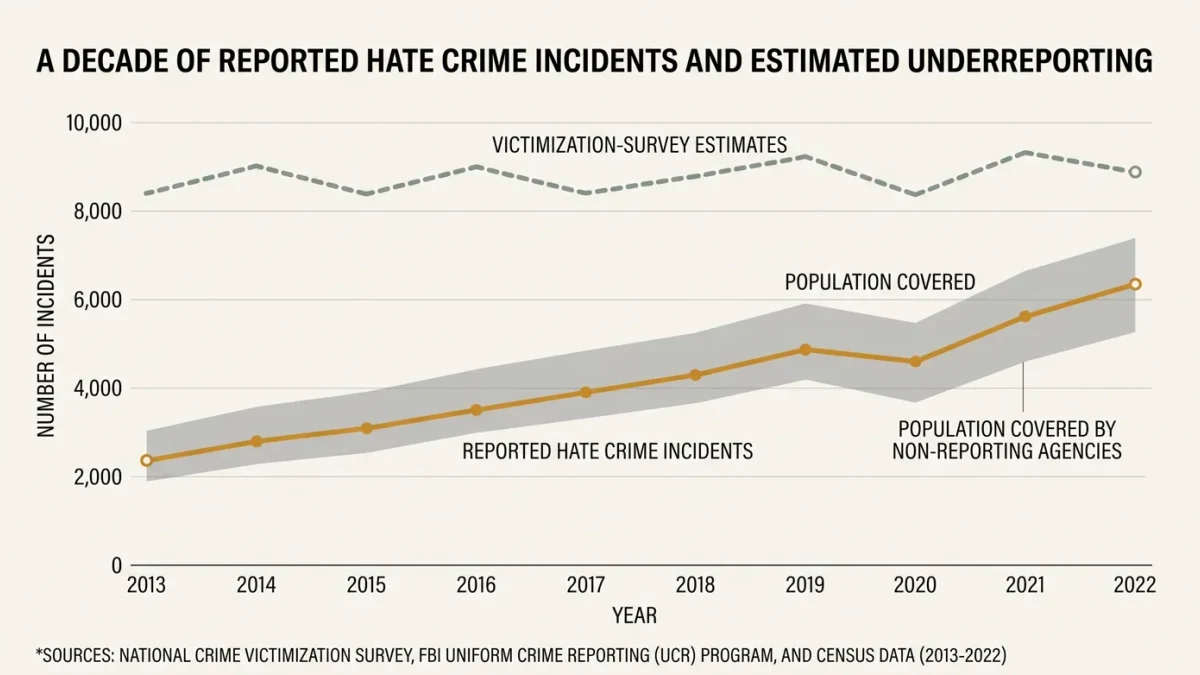
Hate crime data is collected through voluntary submissions to the FBI's Hate Crime Statistics Program, and per the FBI's published 2023 release — the most complete annual file available as of mid-2026 — participating agencies recorded more than 11,800 hate crime incidents, the highest annual count since national collection began. The count is also a documented floor: hundreds of law enforcement agencies, and in some years entire state systems, submitted no data, and victimization research indicates most victims never report to police at all.
Both facts come from federal records; this site publishes information, not legal advice.
How does the FBI count hate crimes?
The process starts locally. When an incident is reported, an officer or detective determines whether the evidence supports a bias motivation — hostility toward the victim's race, ethnicity, religion, sexual orientation, gender identity, disability, or gender, as defined by the Hate Crime Statistics Act and subsequent amendments. Agencies that participate in the FBI program submit incident records with the bias category, the underlying offense, and victim and offender details. The FBI aggregates and publishes annually, without independently verifying each agency's determinations.
The threshold judgment is the pivot. The same assault can be recorded as a hate crime by one department and as an ordinary assault by another, depending on training, evidence collection, and local policy, and per the FBI's own documentation the published figures reflect agency determinations as submitted. A national count built this way measures reported, recognized, and submitted incidents — three filters stacked in sequence.
Why do so many agencies report zero?
Participation is voluntary, and the published files show the consequences. Per FBI participation tables for 2023, a substantial minority of agencies nationwide — several thousand, serving large populations — submitted either nothing or a null response confirming zero hate crimes, and several states have had years with little or no usable statewide data because large departments did not participate. Zero is ambiguous in this data: it can mean no incidents, no recognition, or no reporting, and the file itself does not distinguish the three.
Audits have found the ambiguity is real. Justice Department Inspector General reports and academic reviews have documented agencies recording no hate crimes for years despite incidents that local records show occurred. Because submission quality has no penalty attached, the national series inherits every local gap.
How much crime never reaches the FBI count?
Two undercounts stack. First, reporting to police: per Bureau of Justice Statistics' National Crime Victimization Survey research on hate crime, a majority of perceived hate-crime victimizations were not reported to police in published survey years, with victims citing distrust, fear of retaliation, and the belief that nothing would be done. Second, recognition after reporting: even reported incidents may not be flagged as bias-motivated in the record.
BJS's double-contradiction approach — pairing NCVS estimates with FBI counts — has estimated annual hate-crime victimizations in the range of 200,000 or more in some years, against roughly 10,000 to 12,000 incidents in the FBI file. Per BJS's published methodology, the two series are not directly comparable, since the survey counts victimizations and perceptions while the FBI counts agency-confirmed incidents. But the scale of the gap, an order of magnitude, is the central documented fact of the field.
What do the published trends actually show?
| Indicator | Pattern in FBI published data |
|---|---|
| Incident count | Rose to a record above 11,800 in 2023 |
| Bias motivation | Race, ethnicity, and ancestry incidents the largest share; anti-Jewish and anti-LGBTQ categories consistently among the largest single categories |
| Participation | Thousands of agencies reported zero or no data in each recent year |
| Offense mix | Intimidation, destruction of property, and simple assault dominate; violent offenses a minority |
The trend lines are best read as a floor that rose. Whether the 2022-2023 increases reflect more incidents, better identification, more reporting, or more participating agencies is not separable from the published file — a limitation the FBI's own documentation acknowledges.
How do state hate crime statutes complicate the picture?
Federal collection sits on top of a patchwork of state law. Most states have bias-crime statutes, but the protected categories, the evidence standards for proving motivation, and the penalty enhancements differ, and a handful of states have no comprehensive statute at all. An incident that supports a hate crime charge in one state may support only an ordinary charge in a neighboring one, so the underlying legal landscape varies before any statistics begin.
Charging practice adds another filter. Per published prosecutor surveys and Justice Department case studies, hate crime charges are brought in a small share of eligible cases, because proving motivation beyond a reasonable doubt is harder than proving the underlying offense. The FBI count measures recorded bias incidents, not prosecutions — a distinction that matters when readers try to follow an incident from the national table into any courtroom outcome.
What can a reader responsibly conclude from the numbers?
Three conclusions survive the data's limits. The FBI count is a floor, not a census. Its year-to-year increases mix real change with measurement change and cannot be read as a pure trend. And the groups consistently most represented in the file — per the published categories, victims targeted for race, ethnicity, religion, and sexual orientation or gender identity — mirror the categories with the highest victimization survey estimates, which suggests the bias itself is documented even where the volume is not.
What would make the counts more complete?
The fixes in the policy literature are structural: mandatory participation, which federal legislation proposed in recent Congresses would require; state-level mandates with training funds, which several states adopted after their own undercounts surfaced; standardized bias-crime training for responding officers; and published audits of zero-reporting agencies. Per Justice Department statements through 2025, the department has funded training and encouraged participation, while the underlying voluntary structure remains.
Until then, the honest reading of any hate crime number names its pipeline: a victim must recognize and report the incident, an officer must identify and document the bias motivation, and an agency must submit the record to the FBI. Per the federal data, at every one of those three gates, most of what research measures as hate crime passes through — or is stopped.