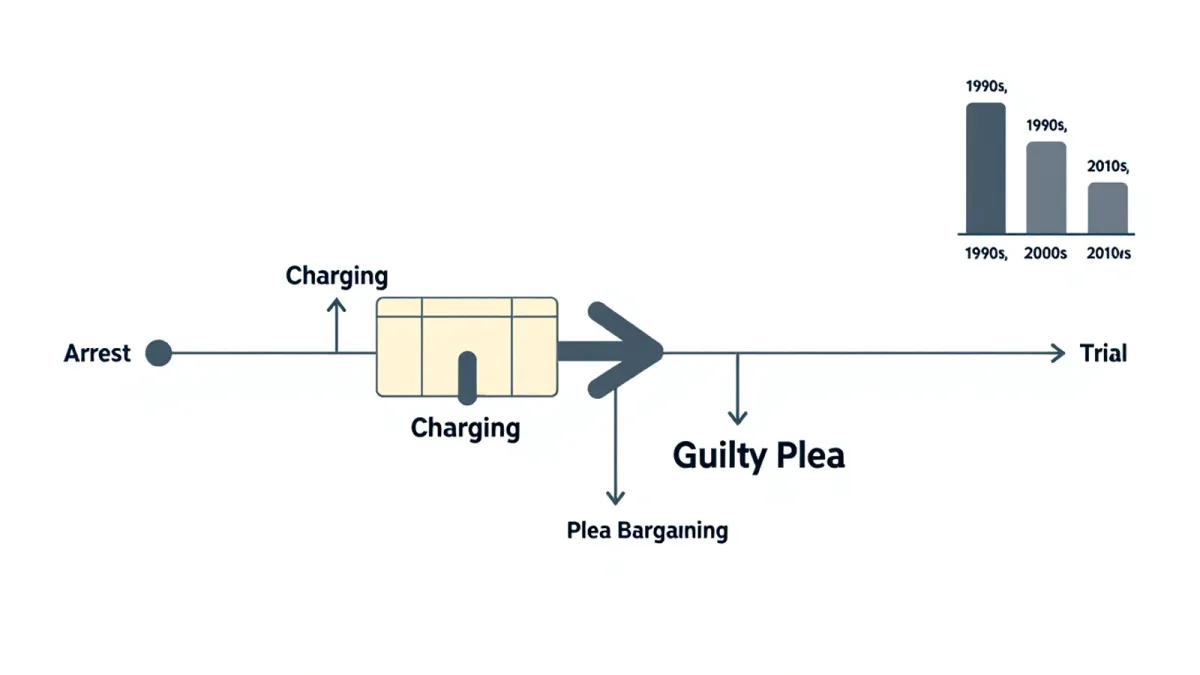
A plea bargain is a negotiated agreement in which a person charged with a crime agrees to plead guilty in exchange for something of value from the prosecution — reduced charges, a lighter sentencing recommendation, or the dismissal of remaining counts. The exchange explains why so few cases reach a jury: in fiscal year 2023, guilty pleas accounted for about 97 percent of federal convictions, per the United States Sentencing Commission's annual Sourcebook, and state systems report comparable shares.
This article explains the mechanics of plea bargaining, what prosecutors and defendants each give up, and the safeguards that are supposed to keep the process honest. It publishes information, not legal advice; a person facing charges should consult counsel licensed in that jurisdiction.
The trial's disappearance is one of the most consequential facts in American criminal justice, and it happened without any legislative vote. Trials appear in the Constitution and in popular imagination as the system's centerpiece, yet they resolve a small residual of the caseload. Understanding plea bargaining means understanding what replaced the trial as the system's actual decision point.
What exactly is being traded in a plea deal?
The currency is certainty. For the defendant, a plea removes the risk of conviction on more serious charges and, in many systems, of a longer sentence after trial. For the prosecutor, a plea guarantees a conviction record without the cost, delay, and evidentiary risk of trial, and it locks in cooperation when the person has agreed to assist in other investigations.
Deals take several recognizable forms:
- Charge bargaining: the prosecutor dismisses or reduces charges — for example, agreeing to a lesser offense rather than the top count.
- Sentence bargaining: the prosecutor recommends a specific sentence or agrees not to oppose a request, which matters most in systems with indeterminate ranges.
- Count bargaining: the defendant pleads to one count and the remaining counts are dismissed at sentencing.
- Fact bargaining: agreement on which facts the prosecution will attribute, which can affect sentencing calculations.
In the federal system, formal sentence bargaining is constrained by Rule 11 of the Federal Rules of Criminal Procedure: a plea agreement can state a recommended sentence, but the judge is not bound by it and must warn the defendant of that fact before accepting the plea.
What does a judge have to approve?
A guilty plea is not a contract the parties can enforce on their own; it must be accepted by a court. Federal judges hold what is called a Rule 11 colloquy — a structured questioning on the record in which the judge confirms the plea is voluntary, that the defendant understands the charges and the rights being given up, and that there is a factual basis for guilt. Most states use a similar procedure.
Two constitutional anchors matter here. In Brady v. United States (1970), the Supreme Court held that a plea entered to avoid the risk of a heavier sentence is voluntary. In North Carolina v. Alford (1970), the Court allowed a plea even where the defendant maintained innocence, if the record contains strong evidence of guilt — the so-called Alford plea, which several states permit and a few forbid. The safeguards exist because a plea waives most rights at once: the rights to a jury trial, to confront witnesses, and against self-incrimination.
Related stories: How statutes of limitations work in criminal cases, and when the clock stops · How appeals work, and what a standard of review actually decides.
Why do so few cases go to trial?
The short answer is that each side's calculus pushes toward settlement. Trials are slow and expensive, courts are congested, and the sentencing difference between losing and pleading at trial can be enormous. In the federal system, the guidelines add a two-to-three level increase for going to trial after accepting responsibility is withdrawn, which is explained in plain terms in the Sentencing Commission's guidelines materials. The gap between a post-trial sentence and a negotiated one is often measured in years.
Volume completes the loop. A prosecutor's office that resolves most cases by plea can move a larger docket; a defense bar spread thin pleads many cases it cannot litigate; and judges manage calendars accordingly. Scholars and reform groups, including the National Association of Criminal Defense Lawyers in its 2022 report on the decline of the federal jury trial, have documented how trial rates fell steadily across decades even as caseloads shifted. The system as built could not function if every defendant exercised the trial right.
Who benefits and who bears the risk?
Both sides gain certainty, but the distribution of risk is uneven, and the research record is careful on this point. Defendants with private counsel or strong cases may extract genuine discounts; defendants held in pretrial detention face powerful pressure to plead quickly regardless of strength, because every week in custody is a week served. Studies compiled by the Bureau of Justice Assistance and academic researchers have found that detained defendants plead earlier and, in some jurisdictions, receive harsher outcomes than similarly situated released defendants.
There is also the category of factually innocent people who plead. The National Registry of Exonerations, a project of the University of California Irvine Newkirk Center, had documented hundreds of exonerations after guilty pleas as of 2025 — a minority of all exonerations, but a persistent one, concentrated in cases with weak evidence or heavy pressure. A plea, once accepted, is difficult to undo: courts generally hold defendants to their statements that the plea was voluntary.
What rights survive a guilty plea?
Fewer than most people assume. A plea typically waives the trial rights and, in the federal system and many states, can include a written appeal waiver. The Supreme Court held in Class v. United States (2018) that a guilty plea alone does not automatically waive the right to challenge the plea's constitutionality on direct appeal, but negotiated appeal waivers are generally enforced. What survives is the right to argue that the plea itself was defective — that the colloquy was inadequate, that counsel was ineffective in a way that infected the plea, or that the prosecution breached the agreement.
Prosecutorial breach is litigated more often than people expect. When a prosecutor reneges on a promised recommendation, the remedy is typically specific performance — the court enforces the promise rather than letting the defendant withdraw the plea, per the framework in Santobello v. New York (1971), the case that first recognized plea bargaining as a legitimate and pervasive practice deserving judicial oversight.
What would make the process fairer?
The reforms most often proposed address information and leverage. They include early disclosure of evidence before the plea decision, reliable data on what sentences comparable defendants actually receive, limits on charges that carry disproportionate trial penalties, and counsel at the plea stage for everyone facing custody. Some states have moved: courts in several jurisdictions now require prosecutors to share their evidence before pleas are accepted, and the National Conference of State Legislatures has tracked these changes. None of them restores the trial; they aim to make the negotiation that replaced it less blind.
For more context, read What a mistrial is, and what happens after one is declared.
For more context, read What an arraignment is, and what happens next.
For more context, read criminal appeal.