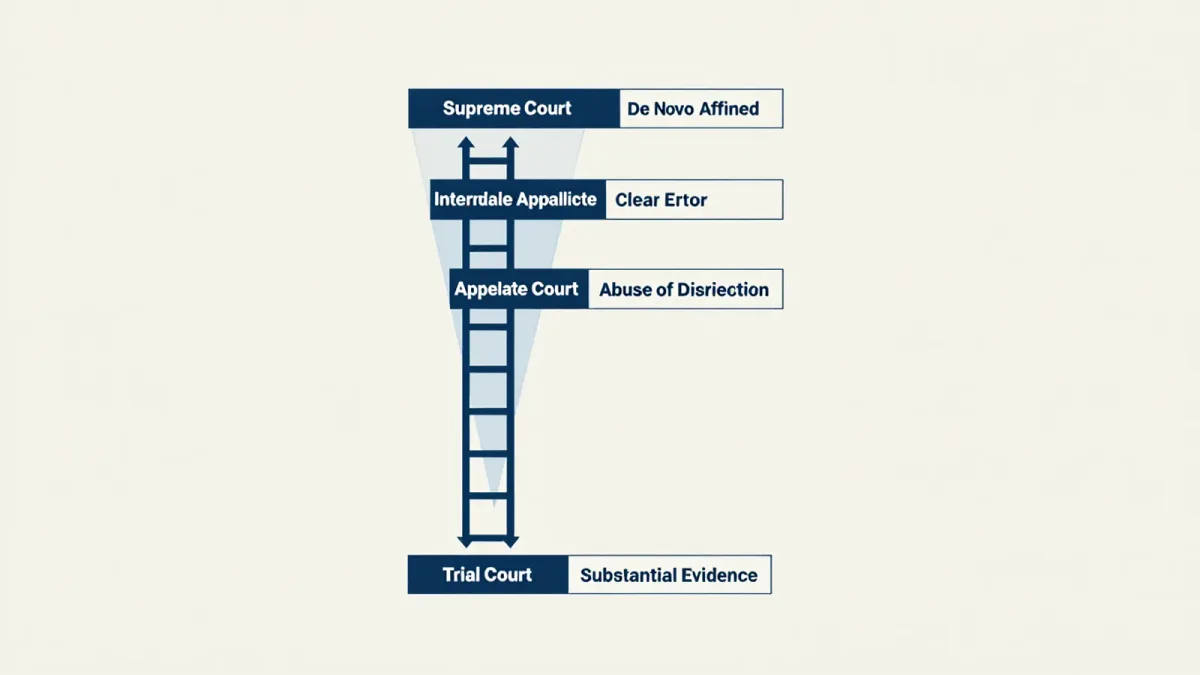
An appeal is a request to a higher court to review a lower court's decision for legal error, made on the record of what already happened below — no new witnesses, no new evidence, no second look at the facts unless the standard of review permits one. What the appellate court may do with that record is set by the standard of review, and in close cases the standard is the outcome.
This article walks through the appellate process in criminal cases, explains the main standards of review, and shows why so many appeals fail at the preservation stage. It publishes information, not legal advice; a person considering an appeal needs appellate counsel quickly, because filing deadlines are short and strictly enforced.
The scale of the filtering is worth seeing first. The federal courts of appeals resolved roughly 48,000 appeals in fiscal year 2023, per the judiciary's annual statistical tables, and reversed only a modest fraction of criminal judgments. Most criminal convictions never get appealed at all; of those that do, most end in affirmance.
What can actually be appealed?
Only final judgments and certain interlocutory orders. A defendant convicted after trial can appeal the conviction and the sentence; a defendant who pleaded guilty generally waived most non-jurisdictional issues in the plea, leaving challenges to the plea itself, to jurisdiction, or to an illegal sentence. The prosecution's appeal rights are far narrower, because double jeopardy bars review of acquittals and the government usually cannot appeal before conviction.
The appeal must rest on something the trial court did wrong as a matter of law — an evidentiary ruling, an instruction to the jury, the denial of a suppression motion, an unreasonable sentence. Disagreement with the verdict is not enough; the jury's factual findings belong to it.
What are the steps of a criminal appeal?
- File a notice of appeal, typically within 14 days of judgment in federal court; many states allow 30.
- Order the trial transcript and secure the record on appeal.
- Brief the case: the appellant's brief states the errors and the argument; the appellee answers; the appellant may reply.
- Oral argument in a minority of cases — most are decided on the briefs.
- Panel decision by two or three judges, or the full court sitting en banc in rare cases.
- Petition for further review — a writ of certiorari to the state supreme court or the U.S. Supreme Court — which is granted in a small share of petitions.
Deadlines govern everything. Missing the notice-of-appeal deadline usually ends the appeal permanently, which is why appellate attorneys emphasize it before any other question is answered.
Related stories: How plea bargains work, and why most criminal cases end without a trial · What mens rea means, and why intent matters in criminal law.
What does the standard of review decide?
It decides how much deference the appellate court owes the trial court, and therefore how bad an error must be to matter. The main criminal standards, from least to most deferential:
- De novo: no deference; the appellate court decides the legal question fresh. Constitutional rulings, statutory interpretation, and the legal adequacy of a guilty-plea colloquy get this treatment.
- Abuse of discretion: the trial court's ruling stands unless it was arbitrary, clearly erroneous in reasoning, or based on a mistake of law. Evidentiary rulings and sentencing decisions live here.
- Clear error: for the trial judge's factual findings, the appellate court affirms unless left with a definite and firm conviction a mistake occurred.
- Harmless error: even a proven error does not win an appeal if the government shows it did not affect the outcome; constitutional errors must be harmless beyond a reasonable doubt, per Chapman v. California (1967).
- Plain error: for issues not preserved by a timely objection, the appellant must show an obvious error that affected substantial rights.
A concrete illustration: whether a warrant lacked probable cause is reviewed de novo as a legal question, but the factual recitals inside the affidavit get clear-error deference. The same document passes through two standards at once.
Why does preservation matter so much?
Because objection is the price of review. Under Federal Rule of Criminal Procedure 52 and its state counterparts, a lawyer who fails to object when the error occurs gets only plain-error review — a steep hill. The logic is that parties should give the trial court a chance to fix mistakes while correction is still possible.
The doctrine reaches its hardest form with ineffective assistance claims: when trial counsel failed to object, the issue is usually deferred to a separate post-conviction motion rather than the direct appeal, per Strickland v. Washington (1984) and the procedural rules built around it. That detour costs years, which is one reason direct-appeal reversal rates stay low.
Can new evidence be added on appeal?
Almost never. The appellate record is fixed; reviewing courts decide whether the proceedings below were lawful, not whether justice would produce a different result with more information. Claims resting on facts outside the record — new witnesses, new forensic reports — belong in post-conviction proceedings, habeas corpus for people in custody, or motions for a new trial based on newly discovered evidence, each with its own deadlines and hurdles.
This is the single most common reader misconception about appeals: they are legal audits, not second trials. A court of appeals reads the transcript, the exhibits, and the briefs, and asks whether the law was applied correctly to what the trial record contains.
What happens after a reversal?
Outcomes vary more than the term suggests. A reversal can mean outright acquittal, as when evidence is legally insufficient — a rare but real outcome. More often it means a new trial, a resentencing, or an order that the lower court reconsider its ruling under the correct law. In sentencing appeals, the remedy is typically remand for resentencing before the original judge, who must now correct the identified procedural error. The process restarts, narrower than before, with only the flagged question open.
One further path deserves mention because headlines blur it: discretionary review. The U.S. Supreme Court receives thousands of certiorari petitions each term and grants a small fraction, concentrating on questions of national significance or deep circuit splits. A state supreme court review or a cert grant is the exception that reshapes doctrine; it is never the ordinary end of a case, and readers should treat any claim of imminent Supreme Court review with that ratio in mind.
For more context, read What an arraignment is, and what happens next.
For more context, read mistrial.
For more context, read plea bargain.