Elizabeth Holmes, the founder of blood-testing startup Theranos, was convicted on January 3, 2022, of one count of conspiracy to commit wire fraud and three counts of wire fraud, and was sentenced to 11 years and three months in prison on December 29, 2022, by Judge Edward Davila of the Northern District of California. The same jury acquitted her on four fraud counts tied to patient test results and deadlocked on three others — a split verdict that is the real lesson of the case about how federal fraud charges are built and proved.
This piece explains what the government had to prove, why some counts failed, and what the sentencing decision says about how judges weigh fraud losses. It publishes information, not legal advice; readers facing actual fraud allegations should consult qualified counsel.
What exactly was Holmes convicted of?
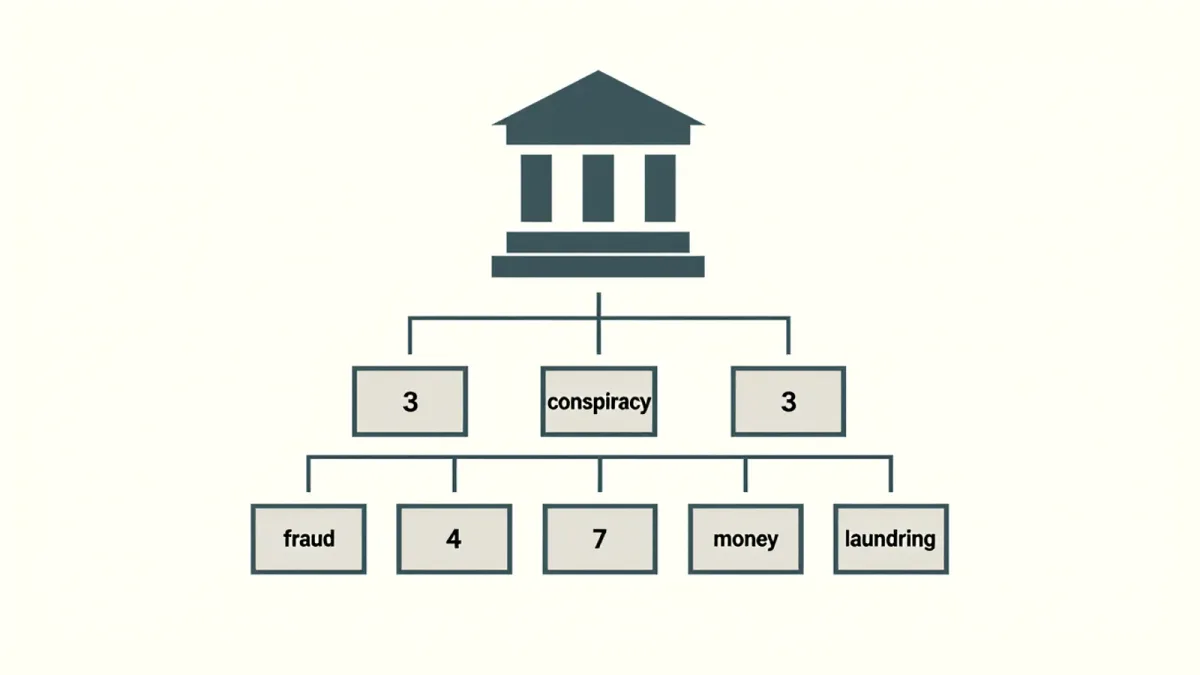
The jury convicted Holmes of defrauding investors, not patients. Count one charged conspiracy to commit wire fraud, and counts two through four charged wire fraud — transactions involving payments into Theranos by investors, including families behind two of the company's largest backers, per the indictment filed in June 2018. Wire fraud, under 18 U.S.C. §§ 1343 and 1349, requires a scheme to defraud, a specific intent to deceive, and a transmission in interstate commerce in furtherance of the scheme.
Prosecutors from the United States Attorney's Office for the Northern District of California argued that Holmes and former president Sunny Balwani knew the company's proprietary devices could not do what was claimed, and that investors were told otherwise. Evidence at the trial included internal emails and text messages, testimony from former employees, and laboratory records showing the volume of tests run on third-party commercial machines rather than Theranos devices.
Why did the jury acquit on some counts?
The acquitted and deadlocked counts alleged fraud on patients and on particular investors, and the jurors apparently were not persuaded the government met its burden on each of them. Fraud prosecutions are proved count by count: each wire count requires proof that a specific transmission furthered a specific deception. A jury that believes the overall story may still find the record thin on particular transactions.
The split also reflects the line courts draw between optimism and deceit. The defense argued Holmes believed in the technology and never intended to deceive anyone. The jury's answer — guilty on investor counts, not guilty on four patient-related counts, no verdict on three more — shows that belief, recklessness, and intent are questions the government must prove beyond a reasonable doubt for each charged act. Holmes was acquitted of those counts and never sentenced on them.
How the case moved from private testing failures to criminal charges
The path ran through journalism, regulators, and then prosecutors. Published reporting in 2015 questioned whether Theranos devices performed as advertised; federal regulators later found deficiencies at the company's California laboratory, and the Centers for Medicare and Medicaid Services moved to ban Holmes from operating a laboratory for two years, per the agency's publicized actions. In June 2018, a federal grand jury in the Northern District of California returned an indictment charging Holmes and Balwani with eleven counts each: conspiracy to commit wire fraud and ten counts of wire fraud. The charges arose from the same core theory — that the defendants made materially false claims about the company's technology, its laboratory performance, and its relationships with commercial partners, first to investors and, in other counts, to patients.
Theranos itself dissolved in September 2018. The criminal case against its founder outlived the company, which is typical: a corporation's end does not end individual exposure for statements made while it operated.
What the trial actually looked like
Jury selection began in August 2021 and testimony ran through December of that year, in a San Jose courtroom with pandemic-era distancing. The government's proof was documentary as much as testimonial. Jurors saw internal emails and text messages in which senior figures discussed problems with the devices; laboratory records showing how many tests were run on modified third-party machines; and validation documents reflecting the gap between what the technology did and what investors were told it could do. Former employees described laboratory workflows and quality-control failures. Witnesses also included investors and business partners who recounted what they had been told before wiring money.
The defense did not dispute that claims made to investors proved false. It disputed intent. Holmes testified in her own defense over several days, describing a founder who believed the technology would work and attributing some misleading statements to Balwani's influence — an allegation he denied, and which his own jury later rejected when it convicted him. Closing arguments framed the same documents two ways: a record of concealment, or a record of a hard technical problem pursued honestly. Juries are asked to pick, and the burden of proof sits with the government on every count.
What does the sentencing decision turn on?
Judge Davila sentenced Holmes to 135 months — 11 years and three months — plus three years of supervised release, on December 29, 2022. Under advisory federal sentencing guidelines, the parties disputed the loss calculation, an aggravating-role adjustment, and whether Holmes deserved credit for acceptance of responsibility. The court also ordered restitution, for which Holmes and Balwani were jointly and severally liable, reported at roughly $452 million across the defrauded investors.
The sentence illustrates how fraud sentences are driven by loss figures under the guidelines, but that judges may vary from the calculated range. Prosecutors had sought a substantially longer term; the defense had argued for home confinement and community service. Davila imposed a term below the guideline range the parties had litigated, citing the need for general deterrence balanced against Holmes's history and characteristics — the conventional structure of a fraud sentencing, in which the guidelines anchor the analysis but do not dictate it.
What does the case change for future prosecutions?
Three things stand out. First, the case confirms that startup founders can be charged as individuals for statements made to investors, with no charge required against the company as an entity. The target is the false statement and the intent behind it, not the corporate form. Second, it shows how prosecutors assemble fraud cases from contemporaneous records — internal messages proved more powerful than any single witness, because they were made at the time and admitted as exhibits rather than contested recollections. Third, the split verdict demonstrates that charging every possible fraud theory is not the same as proving them.
Balwani, tried separately before the same judge, was convicted in July 2022 on all twelve counts he faced and was sentenced to nearly 13 years in prison in November 2022, per the court docket. The two trials, run back to back on overlapping evidence, gave the system a rare controlled comparison: similar records, similar theories, juries reaching different splits. The constant was that each element of each count had to be proved separately — the ordinary machinery of federal fraud law, working in public.
For readers tracking the case now: as of the January 2026 docket, Holmes remained in custody on the December 2022 sentence after reporting to prison in May 2023, and the direct appeal challenging her convictions remained the operative next step. Appeal, not retrial, is the ordinary path after a verdict like this one — and the standard of review on appeal is narrow, focused on legal error rather than a fresh weighing of the evidence.