A South Carolina jury convicted Richard Alexander Murdaugh on March 2, 2023, of murdering his wife, Margaret "Maggie" Murdaugh, and their 22-year-old son, Paul, at the family's Colleton County property on June 7, 2021. After roughly three hours of deliberation following a six-week trial, the jurors convicted him on both murder counts and two weapons counts. Judge Clifton Newman sentenced him the next day to two consecutive life terms without parole.
The trial was the most closely watched state murder case of its decade, but its mechanics were conventional: circumstantial evidence, a motive theory built from financial records, and a defendant whose own sworn testimony became the government's strongest exhibit. This article publishes information, not legal advice.
What was the physical and documentary evidence?
The prosecution's proof was almost entirely circumstantial — no eyewitness, no confession before trial — and it came in two layers. The first was a 41-second video recorded from Paul Murdaugh's phone at the family's kennels at 8:44 p.m. on the night of the killings. The video captured the voices of Maggie and Alex Murdaugh in the background; Paul was killed minutes later, and cell-site data placed Alex Murdaugh's phone at the property. That recording contradicted his repeated statements to investigators that he had been napping at the main house and had not been at the kennels that evening. He did not explain the presence of his voice until he testified, roughly two and a half years later.
The second layer was financial. Over years, prosecutors documented that Murdaugh, a fourth-generation personal injury lawyer, had diverted millions of dollars from his firm and from clients' settlements, and that exposure was about to surface — an audit and confrontation over stolen fees loomed within days of the murders. The state argued that as motive: that Paul's involvement in a 2019 boat accident civil suit, and the depositions it produced, threatened to surface the thefts.
What did the defense argue?
The defense contested the circumstantial case directly: it argued the timeline was impossibly compressed, that no blood or gunshot residue placed Murdaugh at the scene in a way the state could prove, and that a person with no prior violence could not plausibly have shot his wife and son. Murdaugh testified over two days, admitting — for the first time — that he had been at the kennels that night and acknowledging years of opioid addiction and massive financial fraud, while denying the killings. On cross-examination, prosecutors used his admitted deceptions to argue the jury could not credit his account of anything, including his denial of the murders.
The defense also pointed the jury toward alternative theories involving the boat accident case and its surrounding disputes. The jury rejected those theories, and its three-hour deliberation became part of the verdict's own record: the questions were answered quickly because the video and the alibi problem did most of the work.
What happened at sentencing?
Judge Newman imposed two consecutive life sentences on March 3, 2023, noting in remarks that he had known the Murdaugh family and observing the scale of betrayal involved, per the sentencing transcript as widely reported. The consecutive structure foreclosed parole in any practical sense. Murdaugh continues to maintain his innocence of the murders; the conviction stands unless an appellate court says otherwise, and he preserved that posture on appeal.
Whatever one thinks of the sentence, the trial demonstrated a principle worth stating plainly: a defendant's truthful testimony about some crimes — the financial fraud, the addiction, even the presence at the scene — can be weighed by the same jurors assessing the charged crimes, and inconsistency with prior statements is fair game.
What came after the murder verdict?
The financial reckoning followed on schedule. In November 2023, Murdaugh pleaded guilty to federal fraud charges — admitting, in open court, a scheme that stole from clients, including the family of his housekeeper Gloria Satterfield, who died in a fall at the property. A federal judge sentenced him to 40 years in March 2024. In November 2024 he pleaded guilty to 22 state financial crime counts and received a 27-year sentence, resolving those charges without another trial. The murder conviction itself survived appellate review: in January 2025, the South Carolina Court of Appeals upheld the convictions and sentences, rejecting arguments that a controversy involving the county clerk of court had prejudiced the jury, per the court's published ruling.
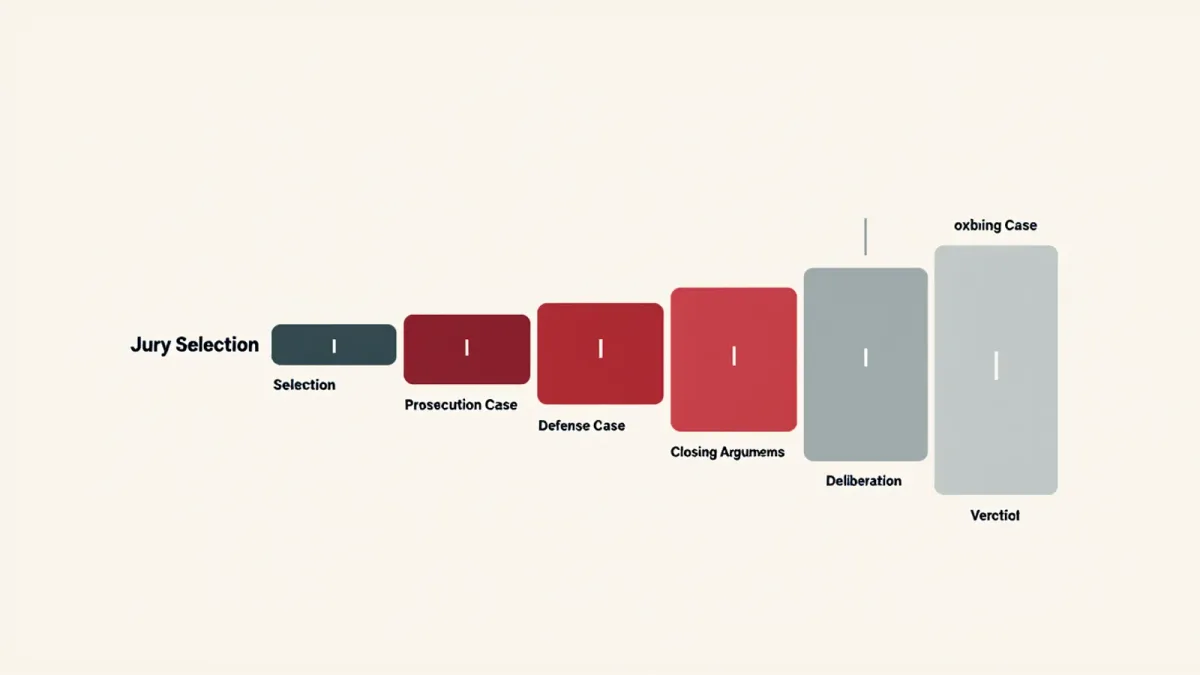
As of early 2026, the case stands as a portrait of a particular prosecutorial architecture: no confession, no eyewitness — instead, a phone video, cell-site records, financial motive, and a defendant on the stand. The system's verdict machinery asked twelve jurors whether that was proof beyond a reasonable doubt. They said it was.
What did the trial show about motive evidence?
The Murdaugh prosecution is now a standard citation for how far motive evidence can reach in a murder trial. The financial crimes were not charged in the indictment the jury decided; they came in through cross-examination and through witnesses who documented the stolen fees, the forged documents, and the audit looming within days of the killings. The court allowed it because motive is relevant to intent, and the defense was free to contest weight, not admissibility. The approach carries risks on both sides: prosecutors must keep the proof tethered to the charged killings, and defendants risk turning a murder trial into a character referendum when they take the stand. Murdaugh's own testimony — conceding the fraud, the addiction, and the lie about the kennels while denying the murders — made the referendum explicit. The jury's short deliberation suggests it treated the documented motive and the dismantled alibi as mutually reinforcing, which is precisely how circumstantial cases are built to work.
Why did the case take two and a half years to reach trial?
The interval between the June 2021 killings and the January 2023 jury selection was filled with documented system friction: SLED, the state investigation agency, took over from local deputies; the circuit's solicitor recused himself for family connections and the attorney general's office prosecuted; and the defense fought battles over evidence and venue while Murdaugh faced the separate fallout of his own staged shooting and the widening financial inquiry. None of that delay is unusual for a capital-tier murder case, though the public attention was. The trial itself ran six weeks in a small county courthouse, streamed live, with the jury sequestered during deliberations. The machinery, in other words, was ordinary even when the docket was not — and the ordinary machinery is what produced the verdict.