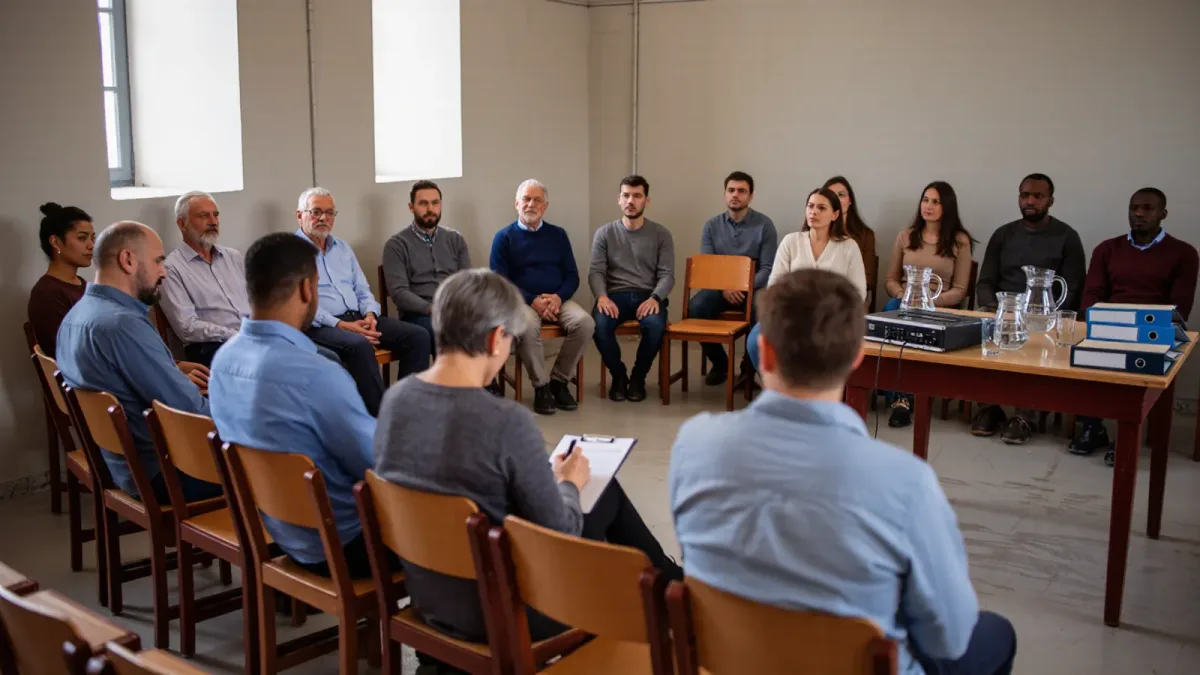
A grand jury is a panel of ordinary citizens who hear the prosecution's evidence in secret and decide whether it justifies filing felony charges. A preliminary hearing is an open court proceeding where a judge makes essentially the same decision after hearing live testimony. Both exist to answer one question: is there probable cause to believe a crime was committed and that this person committed it?
This article explains how each screening process works and why federal cases almost always take the grand jury route while many state cases take the hearing route. It publishes information, not legal advice; anyone with an actual case should consult a licensed attorney in the relevant jurisdiction.
The distinction matters to readers because the screening step shapes everything that follows. It determines whether the public hears evidence before trial, whether the accused can contest the case early, and how much power prosecutors hold at the charging stage. Federal statistics underline the stakes: according to the Federal Judiciary's annual statistics, U.S. attorneys declined to prosecute only a small fraction of matters presented to federal grand juries in recent fiscal years, while grand juries returned indictments in the overwhelming majority of requests — roughly 99 percent in fiscal year 2023, per the Justice Department's annual statistical reports.
What is a grand jury, exactly?
A grand jury is a group of citizens, typically 16 to 23 people depending on the jurisdiction, who meet over weeks or months and review prosecution evidence one case at a time. In the federal system, the Fifth Amendment requires grand jury indictment for all felony prosecutions. The Fifth Amendment's text states that no person shall be held to answer for a capital or otherwise infamous crime "unless on a presentment or indictment of a Grand Jury."
Grand jury proceedings differ from trials in almost every respect. There is no judge in the room — a magistrate or district judge is generally available but not present. There is no defense attorney present, and in most jurisdictions the accused has no right to testify or present evidence. The prosecutor controls which witnesses appear, what questions are asked, and what law is explained to the jurors. Hearsay that would be barred at trial is generally admissible.
How does a grand jury actually proceed?
The mechanics follow a consistent sequence in federal practice:
- Prosecutors present evidence through witnesses and documents, usually over one or more sessions.
- Grand jurors may ask questions, submitted through the prosecutor, and may request additional evidence.
- Prosecutors brief jurors on the elements of the proposed charges.
- The jury votes. Under federal rules, at least 12 of the jurors voting must concur for an indictment.
- If the vote succeeds, the grand jury returns a "true bill" — the indictment — which is filed in the district court and becomes the charging document.
Only the prosecution's side is normally heard. That asymmetry is by design in the federal tradition, and it is the feature critics cite most often. As one common judicial formulation has it, a grand jury would "indict a ham sandwich" if asked — a phrase attributed to various judges and commentators over decades, though its exact origin is disputed. The better-documented pattern is statistical: federal charging requests almost never fail, per the Justice Department's United States Attorneys' Annual Statistical Reports.
Related stories: What a mistrial is, and what happens after one is declared · How federal sentencing guidelines work after Booker made them advisory.
What is a preliminary hearing?
A preliminary hearing is a court appearance, usually within days or a few weeks of an initial arrest, where a judge or magistrate decides whether the prosecution has probable cause to hold the defendant on felony charges. Unlike the grand jury, it is adversarial: the defense attends, can cross-examine prosecution witnesses, and can argue that the evidence is insufficient.
Most states use the preliminary hearing as their primary screening device, either instead of the grand jury or as an alternative. The accused has a right to the hearing in most felony prosecutions, though prosecutors in some states can avoid it by obtaining an indictment first. The hearing is open to the public, generates a transcript, and gives the defense its first realistic look at the prosecution's witnesses — a reason defense attorneys often value it even when they expect to lose.
Probable cause is the same low standard in both settings: facts sufficient for a reasonable person to believe an offense occurred. The judge does not decide guilt, weigh credibility to a certainty, or rule on most evidentiary objections. A finding of probable cause, sometimes called "holding the defendant to answer," sends the case to trial-level court. A failure ends the prosecution unless the state can refile or seek a grand jury indictment where the law allows.
Why does the Constitution require a grand jury only federally?
The grand jury right is one of the few Bill of Rights provisions the Supreme Court has never applied to the states. In Hurtado v. California (1884), the Court held that the Fourteenth Amendment's due process clause does not require states to use grand juries, and it has not revisited that holding since. The result is a two-track system.
Federal felony prosecutions must go through a grand jury indictment, with narrow exceptions such as charged offenses punishable by a year or less. States are free to choose. According to the National Center for State Courts' comparative materials, most states rely primarily on preliminary hearings, while a minority — including New York and Texas for many felonies — require or strongly favor grand jury indictments. Several states allow prosecutors to use either route for some classes of offenses.
Which screening step favors the defense?
The preliminary hearing, in most respects. Its advantages for the accused are concrete: counsel is present, witnesses testify under oath and can be cross-examined, the record is preserved for later use at trial, and an early dismissal is possible. The hearing also forces prosecutors to commit to a theory of the case while evidence is fresh.
The grand jury's defense-friendly features are narrower. Jurors are ordinary citizens rather than judges aligned with the court system, and in a small number of jurisdictions prosecutors must present clearly exculpatory evidence. Federal courts have largely declined to impose such a duty, though the Justice Department's Justice Manual instructs federal prosecutors to disclose evidence that directly negates guilt. Some states go further: New York's procedure, for example, requires prosecutors to present evidence they know to be materially exculpatory, per that state's criminal procedure statute.
What happens after either screening step?
Surviving screening moves the case to the trial court docket. The next milestones are typically arraignment, where the charges are read and a plea is entered, followed by discovery and motion practice. Nothing decided at screening binds the trial jury. A person indicted or held to answer remains legally innocent unless and until convicted — the presumption of innocence governs every later stage.
Dismissal at screening is not always the end either. Where the grand jury route remains available, prosecutors can often present the same case again, and in many states a dismissed complaint can be refiled within the limitations period. Screening tests whether the case is strong enough to proceed, not whether it is strong enough to win.
Why should readers care about the difference?
The screening choice shapes how much of the process the public ever sees. Grand jury secrecy means that in federal cases, the first public account of the evidence usually comes from the indictment itself — a document drafted by prosecutors. Preliminary hearings put witnesses on the stand in open court within weeks of an arrest. For journalists and readers trying to follow a case, the mechanism determines when the record begins, who controls it, and how much can be independently verified before trial.
For more context, read What double jeopardy protects, and where its limits are.
For more context, read What an arraignment is, and what happens next.
For more context, read What a mistrial is, and what happens after one is declared.