The FBI's annual Crimes in the Nation release for 2024, published in September 2025, reported an estimated 4.5 percent drop in violent crime nationwide from 2023, with murder and nonnegligent manslaughter down 14.9 percent and property crime down 8.1 percent, per the FBI's published estimates. The figures come from the agency's National Incident-Based Reporting System, to which roughly 17,000 local, state, and federal agencies contribute incident-level records.
This article summarizes what a federal statistical release can and cannot establish; it publishes information, not advice, and readers evaluating specific cases should consult qualified counsel.
What exactly did the release measure?
The 2024 release counted offenses known to participating agencies, not arrests or convictions. A murder decline of 14.9 percent is an estimate built from agency submissions, weighted where reporting is incomplete. Per the FBI's own materials, the national estimates are provisional in the sense that agencies can submit updated records after publication, and the Crime Data Explorer is refreshed as revised data arrives.
That revision cycle matters. Published crime numbers are best read the way a court reads a docket: as the record as of a stated date, subject to amendment. Clearance classifications, offense codes, and reporting gaps all move the totals without any real change in victimization.
How reliable are the 2024 figures?
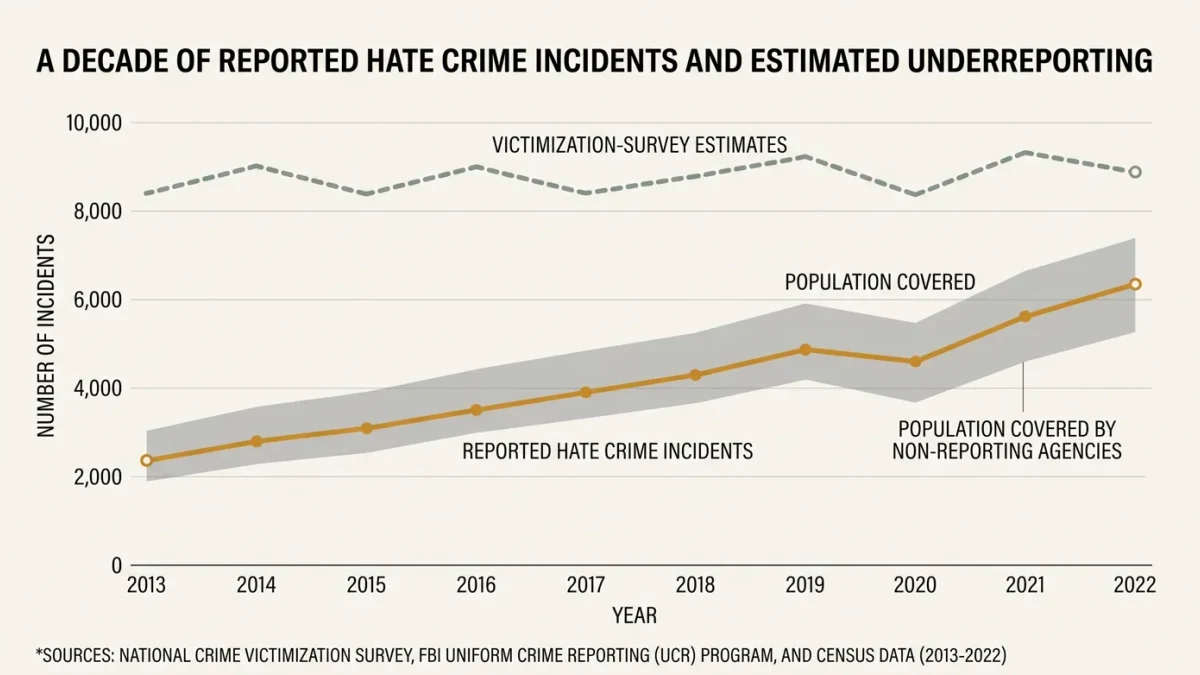
The strongest reading is directional rather than exact. Multiple independent series — the FBI's counts and the Bureau of Justice Statistics' National Crime Victimization Survey — pointed toward declining violence in 2024, which strengthens confidence that a real decline occurred even if the precise percentage is uncertain. Per the FBI release, rape and aggravated assault also declined, and motor vehicle theft fell sharply from its 2023 peak.
The known weakness is coverage. Not every agency reports every month, and participation rates vary by state. The FBI publishes submission-level detail alongside the estimates precisely so users can see where the numbers are thin.
What does the process do next?
Two things follow publication. First, researchers and state statistical analysis centers will decompose the national decline into state and city-level patterns, because a national average can conceal diverging local trajectories. Second, the FBI will continue accepting revisions, and the 2024 estimates may shift in subsequent updates — a normal feature of the system, not evidence of manipulation.
For readers, the practical guidance is to cite the release with its publication date and to check the Crime Data Explorer before repeating any figure that someone quotes secondhand. The number that matters is the one in the record as of the date you are reading.
Why does a data release count as news?
Because the numbers do work in the world. Federal crime estimates shape grant formulas, legislative debates, and public confidence in policing. A 14.9 percent murder decline is not a verdict on any policy; it is a measured outcome that policies must now explain. Treating the release as a starting point for those arguments — rather than a closing statement — is the use the data was built for.